Staff vs. Travel Rad Techs: The Math Behind the Decision
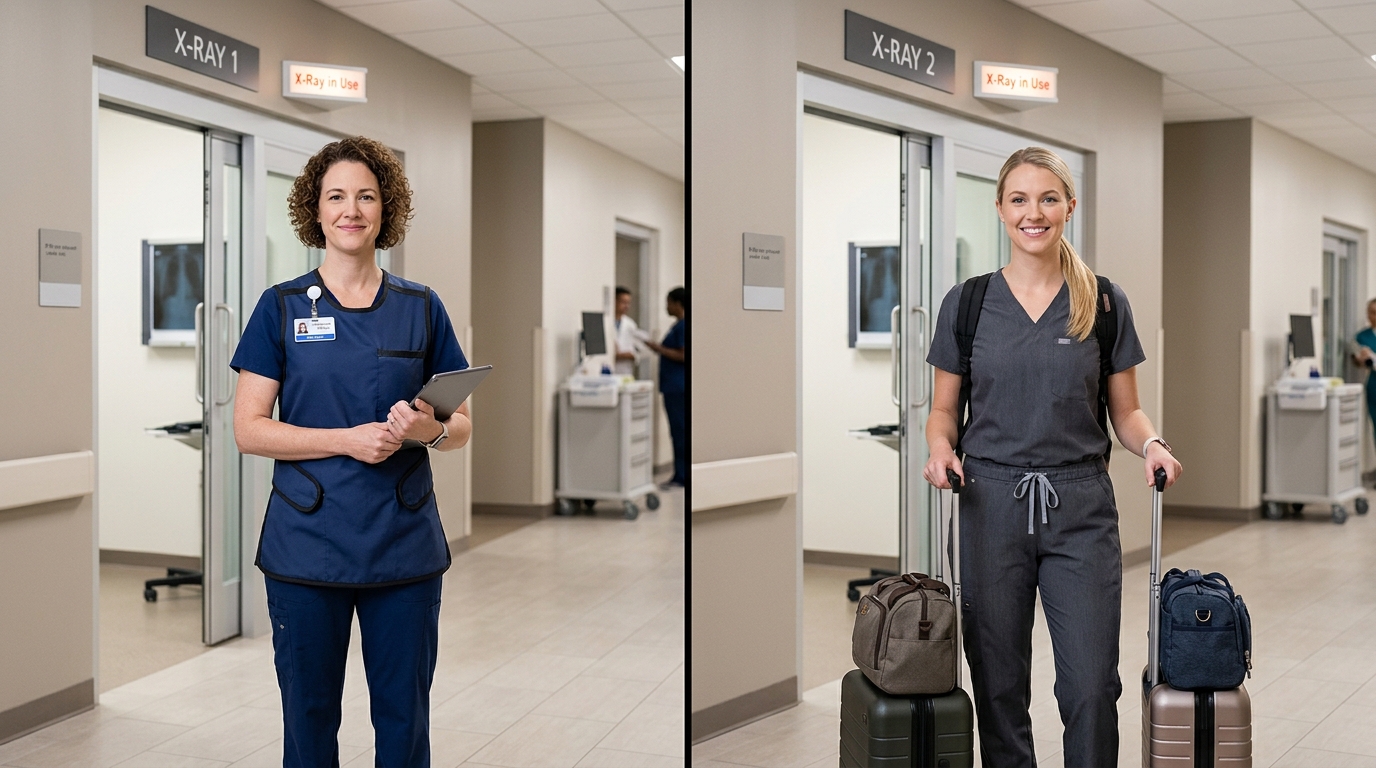
I've lived this decision from both sides. Over seven years as a travel rad tech, I arrived at fourteen different hospital imaging departments with a suitcase and my credentials. I learned more in thirteen-week rotations than I ever expected—different equipment, new protocols, quick adaptation. The experience shaped my career and my understanding of radiology staffing. But here's what I didn't fully appreciate until I moved to the staff side: the true cost of that rotation model, and why many imaging directors make staffing decisions based on incomplete financial pictures.
The "travel vs. staff" debate isn't really about preference. It's about math. And the math is more complex than most decision-makers realize.
The True Cost of Staff Radiology Technologists
Let's start with what seems straightforward: a staff salary. An experienced rad tech in most U.S. markets earns between $65,000 and $85,000 annually. Let's use $72,000 as a reasonable baseline for a mid-sized market.
But that $72,000 salary is just the beginning of the equation.
Benefits and payroll taxes add roughly 25-30% to salary costs. That includes FICA taxes ($5,508), Medicare taxes ($1,044), unemployment insurance ($1,000-$1,500), workers compensation insurance ($900-$1,200), health insurance contributions ($8,000-$15,000 depending on your plan), dental and vision ($1,000-$2,000), retirement matching ($2,000-$5,000), and life insurance ($500-$1,000). For our baseline tech, add $18,000-$22,000 in benefits and taxes.
Recruitment and onboarding costs are significant but often invisible in annual budgets. Posting the position across multiple platforms, reviewing applications, conducting interviews, and administering background checks typically run $1,500-$3,000. But there's more: training time. A new staff tech requires three to six weeks of structured orientation—usually paired with an experienced technologist who's producing zero scans during that time. If we value that mentor technologist at $35/hour and estimate forty hours of training attention, that's another $1,400 in lost productivity per new hire.
Employee retention investments matter too. Professional development, conference attendance, continuing education credits, and credentialing maintenance run $1,500-$3,500 annually per technologist.
Total true cost of one staff rad tech: approximately $95,000-$105,000 per year when you account for salary, benefits, taxes, recruitment, training, and professional development.
But here's the critical part: this is an annual fixed cost you can budget with confidence. You know what you're paying.
The Real Bill Rate Behind Travel Rad Techs
A travel rad tech position advertised at $2,800-$3,200 per week seems like it could save money compared to that $72,000 staff salary, right? Wrong. That weekly rate is what the travel agency bills the hospital—not what you actually pay.
Here's how it breaks down:
A travel agency typically bills hospitals at $2,800-$3,500 per week for an experienced rad tech. This sounds expensive until you realize that bill rate funds: the travel tech's weekly pay ($1,200-$1,600), housing stipends ($800-$1,200 per week), travel reimbursement ($200-$400 per week), the agency's profit margin (25-35%), recruiting costs, marketing, administrative overhead, and liability insurance.
But for the hospital's accounting, the bill rate is what matters. For a thirteen-week rotation at $3,000/week, you're spending $39,000 in direct agency costs alone.
That doesn't include your additional costs:
Onboarding and orientation is compressed but inefficient. A travel tech still needs facility orientation, equipment-specific training, protocol orientation, and credentialing verification. You're looking at 20-30 hours of an experienced staff member's time teaching someone you'll never see again after thirteen weeks. That's roughly $700-$1,050 in productivity loss per new travel tech.
Integration and training loss compounds the problem. Travel techs aren't integrated into your permanent team workflows. They don't know your department's shortcuts, your radiologists' preferences, your specific QA standards, or your informal problem-solving approaches. Studies in healthcare staffing show that travel staff typically operate at 70-80% of productivity compared to long-term staff for the first 4-6 weeks. For a thirteen-week rotation, you're losing roughly $5,000-$8,000 in productivity over that period.
Turnover costs are automatic. Unlike staff positions, there's no retention question—the travel tech leaves when the contract ends. You'll be recruiting, onboarding, and losing productivity again within weeks.
The real cost of a thirteen-week travel tech assignment: $39,000 (bill rate) + $1,000 (onboarding) + $6,500 (productivity loss) + $2,000 (additional integration and management time) = approximately $48,500 per thirteen-week rotation.
Annualized, that's nearly $197,000 for continuous travel coverage at that weekly rate—a significant premium over a single staff position.
Hidden Costs Nobody Talks About
Beyond the direct numbers, there are organizational costs that don't appear on invoices but absolutely affect your bottom line and operations.
Team disruption and culture impact is real. When you cycle through travel techs every three months, your permanent staff can't build cohesive teams, mentorship patterns break down, and institutional knowledge evaporates. Studies in healthcare settings show that high rotation environments experience more medical errors, lower patient satisfaction scores, and faster burnout among permanent staff who become de facto trainers every rotation cycle.
Regulatory and compliance issues emerge when you're constantly training new people on protocols. Credentialing verification takes time. Competency assessments need repeating. Your compliance officer is managing more documentation per technician per year with travel staff than with stable staff.
Equipment and protocol knowledge gaps create inefficiency. Your staff might use advanced imaging techniques or equipment-specific protocols that take weeks for a travel tech to master—and they're leaving right when they're productive.
Management overhead increases. Your imaging director or supervisor spends more time onboarding, evaluating competency, addressing integration challenges, and managing departures with travel staff than with stable employees.
Scheduling complexity becomes a perpetual challenge. You're managing permanent staff schedules while trying to maximize productivity from people who've only been there a few weeks.
When Travel Rad Techs Make Financial Sense
Travel staffing isn't always wrong—it just requires the right circumstances to make financial sense.
Seasonal volume surges are ideal for travel techs. If your volume spikes 30-40% during winter months or specific seasons, bringing in two travel techs for twelve weeks costs roughly $97,000 versus hiring permanent staff for full-time work during slower periods. The math works.
Unexpected leave of absence coverage justifies travel staffing perfectly. When a permanent staff member takes extended leave—medical, family, personal—traveling in someone for that specific duration is far cheaper than recruiting and training a replacement you'll need to lay off after six months.
New facility ramp-up periods are a strong use case. When you're opening an imaging department or expanding significantly, travel staffing can bridge the gap during recruitment and permanent staff integration. The temporary nature matches the temporary need.
Acute staffing gaps from departures sometimes require travel coverage while you recruit permanent replacement. If a staff member leaves unexpectedly and recruitment takes two to three months, two travel assignments provide continuity while you build permanent capacity.
Specialty or niche expertise gaps occasionally justify travel premium. If you need someone with advanced ultrasound skills, cardiac imaging expertise, or specific credential combinations you can't easily recruit locally, a travel assignment might be cheaper than months of recruiting.
The key: travel staffing should solve a time-limited, well-defined problem. It's not a long-term solution disguised as flexibility.
When Staff Radiology Technologists Make Clear Financial Sense
The numbers favor permanent staff in most situations:
Sustained volume. If your department runs consistently, permanent staff builds the stable base you need. That $100,000 annual cost per permanent tech is far cheaper than rotating through expensive travel assignments year after year.
Quality and consistency. Staff techs deliver higher image quality through familiarity with equipment and protocols, reduce retakes (which cost time and radiation), and develop patient rapport that improves cooperation and outcomes.
Longevity and experience. Your third-year staff tech is dramatically more valuable than a first-day travel tech in your facility. They've learned your radiologists' preferences, your equipment quirks, your workflow optimizations.
Compliance and credentialing. Permanent staff streamlines credential management, reduces training repetition, and builds institutional knowledge that actually stays in the institution.
Culture and retention. Permanent positions attract people committed to staying and growing, which builds stronger teams, mentorship pipelines, and department culture.
Cost predictability. That $100,000 annual cost is fixed and budgetable. You can plan around it. Travel staffing costs fluctuate with market rates, availability, and usage patterns—making budgeting harder.
The Hybrid Approach: Staff Core + Travel Surge Capacity
The real answer for most imaging departments isn't "staff or travel"—it's both, deployed strategically.
Build your permanent staff base to handle your baseline volume comfortably. For many mid-sized hospitals, that's 5-7 permanent rad techs. Then use travel staffing for the surges, gaps, and temporary needs above that baseline.
The economics work powerfully:
Permanent staff (5 techs): $500,000/year (including all true costs)
Travel surge capacity (1 tech for 15 weeks, covering peak volume and seasonal demands): $48,500/year
Total annual staffing investment: $548,500
Cost per FTE equivalent: approximately $78,000 (compared to $100,000+ if you tried to hire enough permanent staff to cover peak demand)
This approach gives you:
- Budget predictability and control
- A stable, trained core team that knows your systems
- Flexibility for surges and unexpected absences
- Better team culture and patient continuity
- Lower turnover and training costs
- Compliance and quality consistency
Real Numbers: A Case Study
Let me show this with actual numbers from a facility I worked with:
A 300-bed hospital with volume growing 8% annually faced consistent staffing pressure. Their imaging department had five permanent staff and was using 2-3 travel assignments simultaneously at $3,200/week, costing roughly $312,000-$468,000 annually in travel staffing alone.
We recalculated: hiring two more permanent staff cost approximately $200,000 (including all benefits and onboarding). That hire shifted their staffing model to seven permanent techs plus one rotating travel position for surge/seasonal coverage.
Result: saved $150,000-$250,000 annually, improved team stability, reduced training burden, improved image quality metrics, and actually increased overtime—a symptom of healthier staffing.
The math changed everything.
Making Your Decision
Here's the framework I use with imaging departments:
Calculate your true annual volume needs. Not peak volume—sustainable volume that justifies full-time positions.
Price out permanent staffing for that baseline (salary + benefits + recruitment + training + development).
Identify surge and gap needs above that baseline. Be specific: seasonal surges, expected departures, expansion phases, leave coverage.
Price out travel staffing for those specific needs only, using realistic bill rates ($2,800-$3,500/week depending on market).
Compare the hybrid cost to the all-travel or all-staff alternatives.
Factor in non-financial benefits: team stability, quality, culture, compliance, and retention.
The numbers almost always show that a strong permanent base with targeted travel flexibility outperforms pure travel staffing financially and operationally.
I learned this the hard way—by being on both sides. The travel experience was valuable, but building something permanent? That's where the real impact happens, both financially and clinically.
Need help building your optimal staffing model? RT Job Bank connects imaging departments with vetted permanent rad techs and travel placements. Whether you're building a permanent team or filling surge needs, we've got the staffing solutions your department deserves.
[Find Your Next Rad Tech →]
Related Articles

Burned Out as a Rad Tech? Here's How to Reignite Your Career
April 23, 2026

Managing Up: How Rad Techs Can Influence Department Decisions
April 22, 2026

How to Compete With Travel Agency Pay Without Breaking Your Budget
April 22, 2026
Quality Assurance in Radiology: Why QA Culture Affects Retention
April 21, 2026