The Complete Guide to ARRT Certification
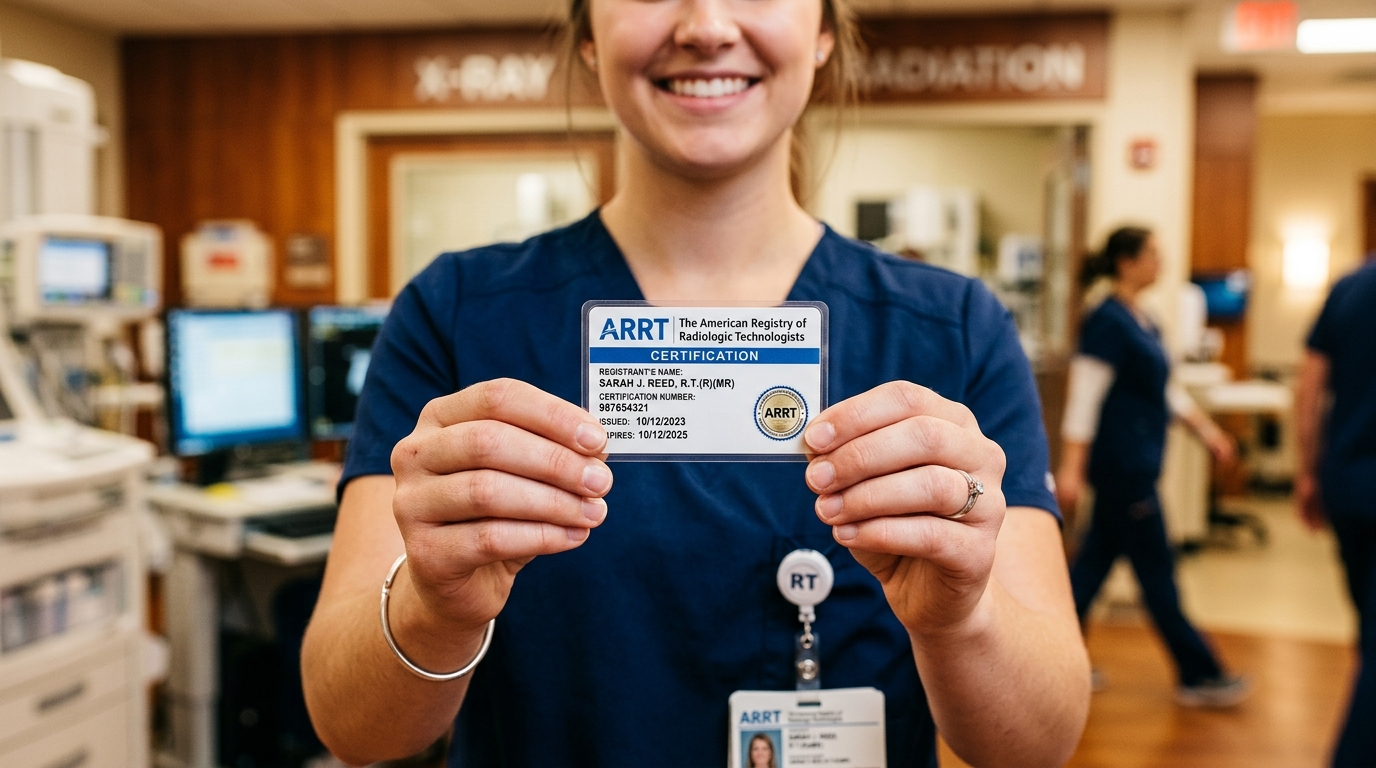
I'm going to be direct with you: I've coached over 200 radiology technologists through career transitions, and I can tell you exactly which certifications move the needle and which ones don't. There's a lot of confusion out there about ARRT certification—what you actually need, what counts toward advancement, what's worth your study time. I'm going to cut through that noise.
Certification matters. It affects your hiring prospects, your pay, and whether you can work in certain facilities or states. But not all certifications are created equal, and the system is more complex than most people realize. Let me walk you through it.
What ARRT Actually Is (And Why It Matters)
First, let's be clear on what we're talking about. The American Registry of Radiologic Technologists (ARRT) is the national credentialing organization for rad techs. When you hear "certified rad tech" or "RT," that's ARRT certification. There are some state-specific certifications and registry options, but ARRT is the gold standard and what most employers recognize.
ARRT doesn't run the schools. ARRT doesn't employ you. What ARRT does is set standards for who's qualified to work in radiologic technology, administer exams, and maintain a registry of certified professionals. When you pass an ARRT exam, you become a registered technologist. That credential has real weight.
Why? Because it means you've met national standards. You've studied specific content, passed an exam, and agreed to follow an ethics code. For employers, especially those working with insurance, accreditation bodies, and patient outcomes, that matters. For patients, it means the person operating their imaging equipment has demonstrable competence.
Primary Certification: Your Foundation
Let's start with the basics. When most people talk about "rad tech certification," they mean primary certification in radiography—what we call R (Radiography). This is what you get after completing an accredited radiography program and passing the ARRT exam.
The exam itself is comprehensive. It covers radiation physics, equipment operation, patient care, anatomy, positioning, safety protocols, and image evaluation. You've got 3 hours and 20 minutes to answer 220 questions, about 200 of which count toward your score. It's not a joke. But if you've completed a solid radiography program, it's absolutely passable.
Here's what I tell people: primary certification is non-negotiable. Full stop. Almost every facility requires it. Some states actually mandate it by law. Even facilities that are desperate for techs because of the rad tech shortage won't hire you without at least being certification-eligible or holding active ARRT credentials.
The cost is around $100 for the exam. Application fees might be $75-$100 additional. It's not expensive relative to what you're investing in your education. Take it seriously.
Post-Primary Certifications: Where Your Specialty Matters
This is where things get interesting—and where I see people make both smart and not-so-smart decisions.
After you have primary radiography certification, you can pursue post-primary certifications in specific imaging modalities. These are the big ones:
CT (Computed Tomography): This is hugely popular right now. CT technologists are in enormous demand, and CT-certified techs typically earn more—we're talking $5,000-$10,000+ per year more than basic radiography. The exam focuses on CT-specific physics, protocols, contrast management, patient safety, and artifact recognition. If you enjoy problem-solving and detailed work, CT is fantastic.
MRI (Magnetic Resonance Imaging): Full transparency—I'm biased here because I'm MRI-certified. MRI techs are incredibly sought after. The credential is called ARMRIT (Advanced Registered Technologist). MRI requires specific knowledge about magnetic fields, safety protocols, and physics that's really different from X-ray modalities. MRI jobs pay very well, and the work is engaging. The tradeoff is that MRI is challenging—there's a steeper learning curve, and the safety implications are significant.
Nuclear Medicine and PET: These fields deal with radioactive materials and require additional safety training. They're more specialized, so there are fewer jobs, but nuclear medicine techs often earn premium pay. If you're interested in molecular imaging and radiopharmaceuticals, this is your path.
Breast Imaging/Mammography: This specialization is critical right now. There's a documented shortage of mammography technologists, and the job is incredibly rewarding. The work involves patient education, screening protocols, and diagnostic mammography. Pay is competitive, and demand is high.
Interventional Radiography: This is where radiography meets surgery. You're working in procedure rooms, assisting with vascular interventions, biopsies, and other minimally invasive procedures. It's fast-paced, the pay is excellent, and the work is varied.
Sonography/Ultrasound: This is technically a separate credential path, but many rad techs transition into sonography. The imaging world is increasingly blended.
Now, here's the strategic piece: which one should you pursue? That depends on three things: (1) What's available where you want to work? (2) What genuinely interests you? (3) What's in demand?
I've seen too many people chase high-paying specializations they don't actually enjoy. A CT tech earning $80,000 who hates the work will burn out. An MRI tech making $85,000 who finds the physics fascinating will thrive and likely advance into lead tech or educator roles.
My recommendation: pick something that combines genuine interest with market demand. Right now, that's CT, MRI, mammography, and interventional. If you're trying to maximize both pay and job security, those are your strongest bets.
The Continuing Education Game
Here's something that trips people up: getting certified is just the beginning. You have to stay certified.
ARRT requires continuing education (CE). You need 36 CE credits every two years to maintain your credential. That's not outrageous, but it requires planning. Most employers help with this—they'll pay for or subsidize continuing education. Some offer in-house CE opportunities.
The ethics requirement is important: you need at least one CE credit every two years specifically addressing the ARRT Standards of Ethics. This is mandatory. You can't skip it even if you have extra CE credits otherwise.
Here's the thing: if you're pursuing post-primary certifications, continuing education becomes part of your life. MRI requires 24 CE credits every three years and ethics every two years. CT requires 36 CE credits every two years. These are specifically in that modality—general radiography CE doesn't count toward MRI maintenance, for example.
I'm going to be honest: this is a pain. But you know what? It's also an advantage. Mandatory continuing education means you're constantly learning. You're staying current with new protocols, new research, new equipment. That's actually good for patient care and for your job security.
How Certification Actually Affects Your Paycheck
Let's talk money because that's real.
According to recent Bureau of Labor Statistics data, the median annual wage for radiologic technologists is around $68,000. Entry-level rad techs make closer to $45,000-$55,000. Experienced techs with primary certification make $70,000-$85,000 depending on location and experience.
But specialty certifications? That changes the equation:
- CT-certified techs average $75,000-$90,000
- MRI-certified techs average $78,000-$95,000+
- Mammography-certified techs average $70,000-$85,000 (with location variation)
- Interventional-certified techs average $80,000-$100,000
These aren't incremental bumps. These are meaningful salary differences that compound over a career.
I coached a tech named Maria who was making $65,000 as a general radiographer. She pursued CT and MRI certifications over three years. Last year, she was making $92,000 and received a signing bonus at her current hospital because they actively recruit dual-certified techs. Over her career, that difference could be $500,000+.
But here's the catch: you have to actually work in that modality. You can't get CT certified and then never work CT and expect to keep making CT money. Employers are smart about this. You have to be current in your specialty.
Common Certification Questions (Answered)
"Do I need a Bachelor's degree to get ARRT certified?"
No. You can get ARRT-certified with an Associate degree from an accredited program. That said, more facilities are now preferring or requiring Bachelor's degrees for new hires. It's not an ARRT requirement, but it's becoming a hiring trend. If you're early in your career, consider a four-year program. If you're already working, don't panic—you can often complete a Bachelor's degree while working.
"Can I challenge the exam without completing a program?"
Not through ARRT. You have to complete an accredited radiography program. This is intentional—it ensures everyone has systematic training. There's no shortcut here.
"How many post-primary certifications should I get?"
My honest answer: one or two, max. Getting three post-primary certifications is possible but exhausting. I recommend getting your first specialty cert (whichever calls to you), getting really good at it, then deciding if you want a second. Being excellent in one specialty is better than being mediocre in three.
"Is ARRT the only option?"
Mostly, yes. Some states have their own certification boards, but ARRT is the national standard. Some facilities might accept other credentials, but ARRT is what I'd recommend. It's portable—if you move states or change employers, ARRT credential follows you.
"What happens if I fail the exam?"
You can retake it. The unlimited retake policy has changed over the years, so check current ARRT rules, but generally you can try again after waiting a period. I've coached people who failed the first time and passed the second. It happens. Don't let one failure derail you.
The Real Career Impact
Here's what I've observed coaching 200+ techs: certification isn't just about credentials. It's about trajectory.
Certified techs get hired faster. They command better pay. They have more negotiating power. They can transition between facilities and specialties more easily. They're eligible for lead tech and educator roles, which open doors to different career paths entirely.
If you're serious about radiology technology as a career, not just a job, get certified. Then stay certified. Then consider specialization. That progression transforms your career arc.
The rad tech shortage is real, and it's actually helping technologists right now. Facilities are hiring people who are certification-eligible but not yet certified. But don't count on that lasting. Professionalize yourself. Get the credential. The investment pays dividends.
Related Articles

Burned Out as a Rad Tech? Here's How to Reignite Your Career
April 23, 2026

Managing Up: How Rad Techs Can Influence Department Decisions
April 22, 2026

How to Compete With Travel Agency Pay Without Breaking Your Budget
April 22, 2026
Quality Assurance in Radiology: Why QA Culture Affects Retention
April 21, 2026