How to Build a Rad Tech Referral Program That Fills Positions Fast
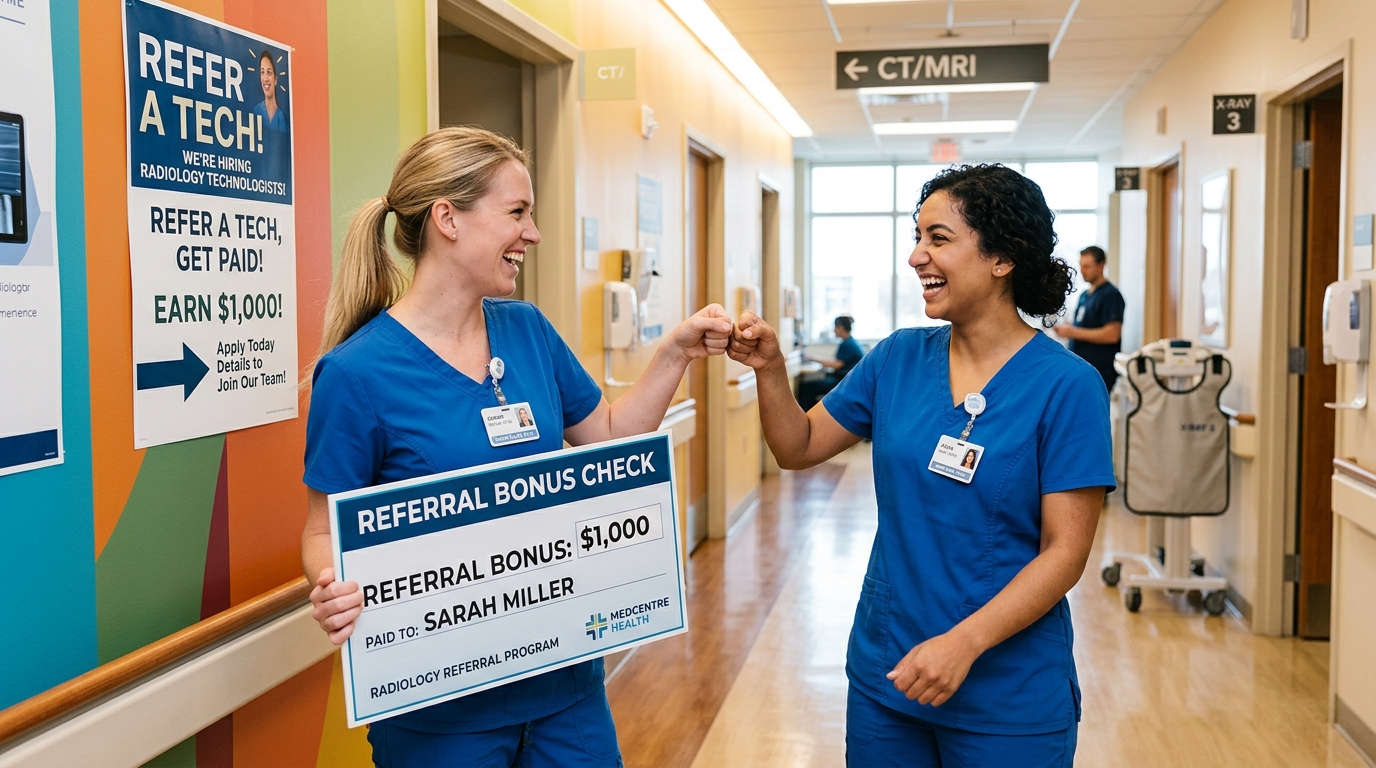
I spent eight years managing imaging departments and I can tell you with absolute certainty: employee referrals are the most cost-effective way to fill radiology technologist positions. Period.
Here's why: A bad hire as a rad tech costs you $45,000-$60,000 in recruiting, training, lost productivity, and eventual separation. A good hire through an employee referral costs you a $2,000-$4,000 bonus and happens in a fraction of the time.
But—and this is critical—most facilities completely botch their referral programs. They'll say "we pay a $1,500 referral bonus," and then they don't follow up, they don't make it easy for employees to refer people, and they wonder why nobody participates.
I've now spent three years building referral programs for imaging networks, and I've seen what works and what's a complete waste of money. Let me give you the full playbook.
Why Referral Programs Win for Rad Tech Hiring
Before we get into structure, let's acknowledge why referrals are so powerful for your specific field:
Rad techs know other rad techs. Unlike general healthcare hiring, your employees actually know qualified candidates personally. They're not randomly pulling from LinkedIn. They know whether someone is reliable, competent, and a good team fit.
Cultural fit matters in small teams. Imaging departments are usually small teams. A personality mismatch is painful. Your existing techs will only refer people they're confident will work well with the team.
Quality is higher than job boards. I can post on a general job board and get 80 applicants, 70 of whom are unqualified. I get a referral from one of my techs and it's pre-screened. They're not going to risk their reputation by referring someone incompetent.
Speed is dramatically faster. Posting a job on a board, waiting for applications, reviewing resumes, scheduling interviews, negotiating offers—that's 6-8 weeks. A referral can be hired in 2-3 weeks from introduction to start date.
Retention is better. Referred employees, on average, stay 40% longer than external hires. Why? Because they have social connections already. They came in through someone they trust. They feel ownership of being part of a community.
The Broken Program: What Most Facilities Get Wrong
Before I show you the right way, let me point out the wrong ways I see constantly:
The "We Have a Referral Program but Nobody Uses It" Trap
Facilities post a vague policy: "refer someone and get $1,500." Then:
- Nobody's really sure how to do it
- The process requires five forms and HR approval
- They don't actively encourage it
- Bonuses take four months to pay out
- Result: zero referrals
The "Tiny Bonus" Mistake
$500 referral bonus for a position that would cost $8,000 to recruit externally? Your techs do the math. They're not going to spend their credibility and effort for $500.
The "Random Payout Timing" Problem
You tell someone they'll get a bonus "when the person is hired and completes 90 days." Then:
- It takes 5 weeks to do final hiring paperwork
- The new hire's 90 days extends to 130 days because of payroll processing
- The bonus finally processes 140 days later
- Your referring employee has forgotten about it
- Result: no follow-up referrals
The "No Communication" Issue
You get a referral, you interview them, you don't hire them, and you never tell your referring employee why. They think you ghosted their friend. Your relationship suffers.
The Referral Program That Actually Works
Here's the structure I've built and refined, and it actually produces results:
Step 1: Clear, Attractive Bonus Structure
Make it obvious what you're offering:
For Full-Time Rad Tech Positions:
- $3,000 for hiring (paid at 90 days when the person is established)
- Bonus paid in a lump sum (not stretched out—people remember $3,000, they don't remember $50/month for 60 months)
- Bonus paid via check separate from payroll so it's visible and meaningful
For Part-Time or Limited Hour Positions:
- $1,500-$2,000 (proportional to the role)
For Specialized Positions (interventional radiology, MRI, etc.):
- $4,000-$5,000 (these are harder to fill, the bonus reflects that)
Why these numbers? Because they're meaningful. A tech looks at $3,000 and thinks, "That's worth spending 30 minutes making a phone call to someone I know." $500 and they think, "Yeah, maybe if I run into them."
I also recommend a "team bonus" for high-volume referral programs: if the department reaches a target number of successful referrals in a year, everyone in that department gets a smaller bonus ($200-$500). This incentivizes the whole team to encourage referrals, not just individuals.
Step 2: A Super Simple Process
Make it impossibly easy to refer someone. Here's what works:
Option 1: Digital Referral Form (Best) Create a simple online form that takes 60 seconds:
- Referring employee name
- Referred candidate name
- Referred candidate phone number
- Position they're interested in
- How you know this person
That's it. Five fields. Takes less than a minute.
Option 2: No-Form Referral (Also Good) Alternative: employee texts/calls HR or their manager with the referral. Someone in HR creates the form. Even simpler.
The key is: don't make your employees fill out a "Detailed Referral Packet" with three pages of requirements. They won't do it.
Step 3: Transparent Communication Back to the Referring Employee
This is where most programs fail. You need a communication loop:
When a referral comes in, someone should contact the referring employee within 24 hours: "Hey Sarah, thanks for referring Marcus. We got his info and we're going to reach out this week."
Then:
- Update them when the candidate is interviewed
- Let them know the outcome (hired or not hired)
- Explain briefly why if not hired ("great person, but CT experience wasn't quite at the level we needed")
- Confirm when the hire date is
- Send a reminder when the 90-day bonus is about to be paid
This communication takes 5 minutes total and dramatically increases program engagement. Your employees feel respected. They know their referral mattered.
Step 4: Strategic Promotion
Don't assume people know about your referral program. You need to actively promote it:
At departmental meetings: "We have an open CT position. If you know someone, here's how to refer them—and you'll get $3,000 if they're hired."
In email: Monthly or quarterly emails from leadership: "We're actively recruiting. Referrals fill faster and pay $3K. Here's how..."
In the break room: Physical poster with the process and bonus amount. Make it visible.
In new hire orientation: Tell new employees immediately about the referral program. They just moved to town, they might have friends they know from their previous facility who'd be interested.
One-on-one conversations: Managers should occasionally ask: "Do you know anyone looking for work?" Makes it conversational, not transactional.
Step 5: Bonus Payout Logistics
Make sure the bonus actually happens and happens on time:
Timeline:
- Employee refers someone
- Referred candidate is interviewed and hired
- Start date is set
- At 90-day mark: approve bonus
- Within 30 days of 90-day mark: issue bonus
Payment method:
- Separate check (not in regular paycheck) so it's visible
- Include a note: "Referral bonus for [candidate name]"
- Consider a small acknowledgment (email from manager, mention in meeting) when bonus is paid
One program I helped with added a small bonus payout celebration. When someone got a referral bonus, their manager sent a nice email to the department: "Sarah's referral of Marcus just earned her a $3,000 bonus. Thanks Sarah for helping us build great teams."
Sounds cheesy, but it worked. Referral submissions increased because people saw their peers get recognized.
Real Example: What Worked at One System
I want to walk you through a real case. A 120-bed regional hospital had an imaging department with chronic staffing issues. High turnover, reliance on travel contracts, frustrated management.
Here's what they did:
Month 1: Program Launch
- $3,000 bonus for full-time rad tech hires
- Created a simple one-page referral form
- Sent emails to all tech staff explaining the program
- Held a brief meeting: "We're struggling to find people. You know good people. Refer them, get $3K."
Months 2-3: Active Recruitment Using Referrals
- Two referrals came in week one. Both interviewed. One hired.
- Manager made a big deal of it: highlighted the referring tech in department huddle, confirmed the bonus would be paid
- More referrals came in
- By end of month 3, they'd hired 3 people through referrals
Months 4-6: Momentum
- Referral bonuses started hitting accounts ($3K checks)
- Referring employees told their friends "yeah, they paid me already"
- More referrals came in
- They filled 2 additional positions through referrals
By End of Year:
- 5 people hired through employee referrals
- Average time-to-fill: 22 days vs. 65 days for traditional recruiting
- Retention rate: 94% (vs. 72% for external hires)
- Total cost: ~$15,000 in referral bonuses
- Traditional recruiting cost for 5 positions would have been ~$25,000 in recruiter fees + staff time
The program paid for itself on the first hire and generated pure value after that.
Advanced Strategies: Maximizing Your Program
Once your basic program is running, you can add sophisticated elements:
Tiered Bonuses for Hard-to-Fill Positions
- Standard CT tech: $3,000
- Interventional radiology: $4,500
- Mammography specialist: $4,500
- Night shift positions: add $500 premium
This tells your employees: "We're most desperate for these roles, so these get higher bonuses."
Department-Level Incentives Track referral success by department. At year-end, if the radiology department had 6+ successful referrals, everyone in radiology gets a $300 bonus. Incentivizes the whole team to promote the program.
Referral Contests "Most referrals in Q2 wins a $500 bonus." Creates friendly competition.
Extended Referral Periods Pay a smaller bonus (maybe $500) if someone stays longer than 12 months, then 18 months. Rewards long-term retention.
What NOT to Do
Just so we're clear, here are the approaches I've seen fail:
- Making the process complicated. If it takes more than 5 minutes to refer someone, nobody does it.
- Delaying bonus payment. If someone doesn't see the money within 5 months of referring, they forget and stop referring.
- Low bonus amounts. $500 doesn't motivate. $3,000 does.
- No communication back to the referring employee. If they don't know what happened to their referral, engagement drops.
- Passive program. If you're not actively promoting it, people forget it exists.
Building a Rad Tech Referral Culture
Here's the real goal: making referrals part of your departmental culture.
When referrals are normalized and rewarded, your techs naturally think of you when they meet someone looking for work. They recommend the facility to colleagues. They actively recruit on your behalf.
I had a manager tell me: "My best techs now bring me referrals automatically. They see a job opening on a board and they text me people they know. The program essentially runs itself."
That's the end state. It takes 6-12 months to build, but it's real.
Your Next Steps
If you're building a referral program from scratch:
- Get leadership buy-in on the bonus budget ($3-5K per successful hire)
- Create a simple referral form (online or paper)
- Brief your team on how it works and why it matters
- Commit to communication back to referring employees
- Track results so you know what's working
- Celebrate wins when people are hired through referrals
If you already have a program that's not working:
- Audit why. Is the bonus too small? Is the process too complicated? Is communication missing?
- Fix the biggest problem first
- Relaunch and re-promote the improved program
- Give it 3-6 months to see if engagement increases
The Reality
Employee referrals won't solve a broken work environment or a facility with terrible pay. But if you're offering decent compensation and a reasonable workplace, referrals are the fastest, cheapest, most reliable way to fill rad tech positions.
I've now helped multiple health systems launch referral programs, and the pattern is always the same: initial skepticism, quick wins, momentum, and then a self-sustaining pipeline.
Your current employees are your best recruiters. You just need to structure it right and reward it appropriately.
Do that, and you'll never post a job opening to a board again without first checking with your own team.
They'll fill your positions faster and better than any external recruiter ever could.
Related Articles

Burned Out as a Rad Tech? Here's How to Reignite Your Career
April 23, 2026

Managing Up: How Rad Techs Can Influence Department Decisions
April 22, 2026

How to Compete With Travel Agency Pay Without Breaking Your Budget
April 22, 2026
Quality Assurance in Radiology: Why QA Culture Affects Retention
April 21, 2026