Ultrasound vs Radiology: Helping Prospective Students Choose
I get asked this question at least twice a month, and I always start with the same disclaimer: I'm not objective. I fell in love with nuclear medicine because I like being a detective—following isotopes through the body, seeing physiology instead of just anatomy. That bias shapes how I see ultrasound and radiology work.
But I also work in a multimodality imaging center where I interact with ultrasound techs, radiologists, CT techs, and radiography techs every single day. I've seen enough of both worlds to give you a real comparison that goes beyond the surface-level stuff.
So here's what you actually need to know if you're deciding between ultrasound and radiology.
The Fundamental Difference
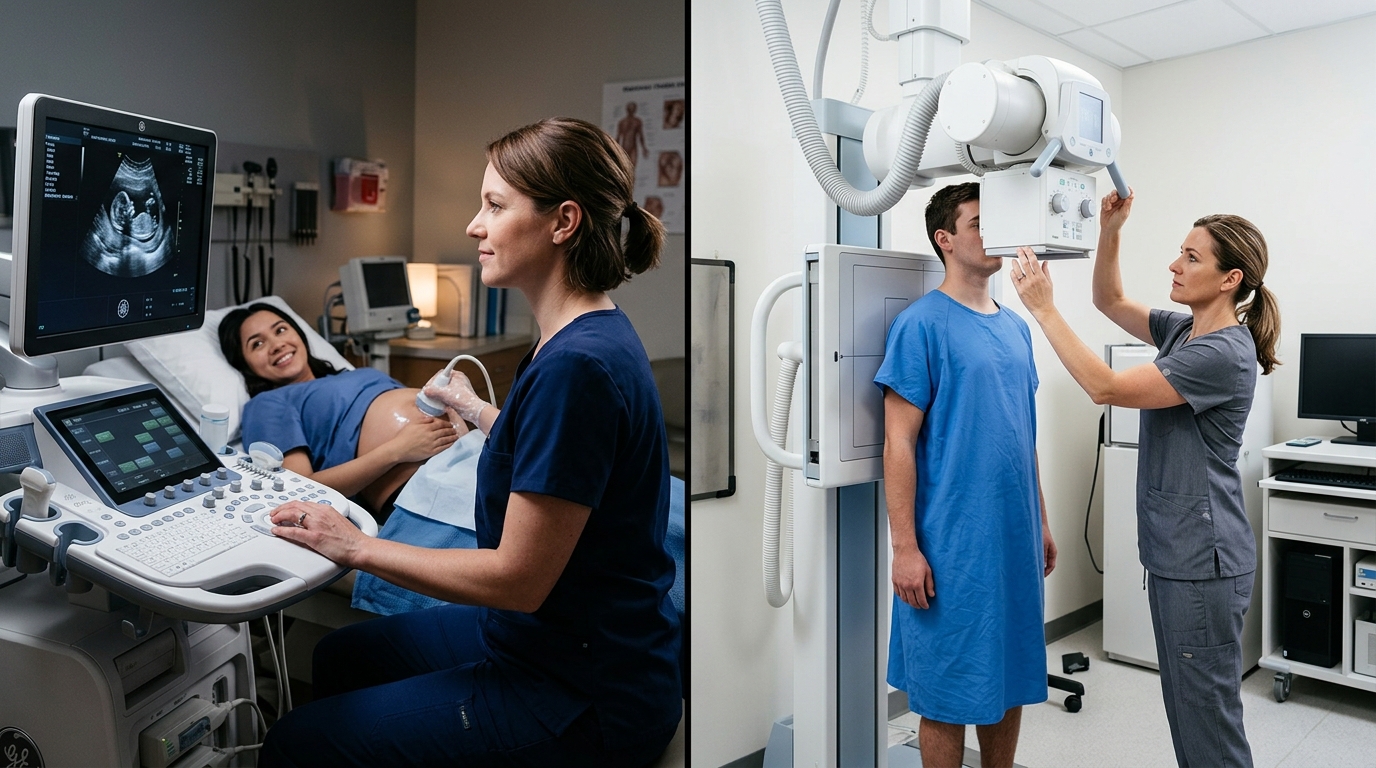
The most important thing to understand is that ultrasound and radiology are fundamentally different types of work, even though they're both medical imaging. They look similar from the outside—you're positioning patients, you're working with imaging technology, you're helping diagnose conditions. But the actual experience is completely different.
Radiography (general radiology, CT, fluoroscopy) is about acquiring images quickly and consistently. You're positioning the patient, you're taking images based on a protocol, you're delivering those images to a radiologist who'll interpret them. The work is relatively standardized. You're doing the same projections for a chest X-ray whether your patient is in Dallas or Denver. The protocol is the protocol.
Ultrasound is about real-time image interpretation and diagnosis. You're not just acquiring images; you're looking at those images as you're acquiring them, you're making clinical decisions about what to scan based on what you're seeing, and you're often communicating directly with the ordering physician about findings. It's much more diagnostic in real-time.
This means the learning curve is different. With radiology, you're mastering positioning and technique. With ultrasound, you're developing a deep understanding of anatomy as seen in real-time, learning to recognize pathology, and sometimes you're the first person to identify something abnormal.
That sounds great—more autonomy, more diagnostic role. And it is. But it also means the stress profile is different. When you're acquiring an X-ray, it's done in seconds. You move on. With ultrasound, you're responsible for the quality and completeness of the exam while you're performing it. That's a different kind of cognitive load.
Training Time and Investment
Here's a concrete difference: radiology programs are typically 2 years. Ultrasound programs are typically 2-4 years, depending on whether you do a general sonography program or specialize afterward.
General radiography or CT? 2-4 semesters. You can be working and earning by your mid-20s. That's legitimate.
Sonography? If you do a direct-entry program, you're looking at 2 years minimum. If you're doing it after an existing rad tech credential (which many programs prefer), you're looking at another year or two. Total time investment is substantial.
This matters for your financial planning. You'll spend more time and money on ultrasound training. Your earning potential is higher, but you need to factor in the longer path to get there.
Also, ultrasound prerequisites are more demanding. Most sonography programs want a solid foundation in anatomy, physiology, and physics. Some radiology programs are a bit more flexible. Not all, but some. If you're not strong in science, ultrasound training will be harder.
The Day-to-Day Experience
Let me tell you what I observe every single day in our imaging center:
Our radiography and CT techs clock in, they review the schedule, they work through a consistent flow of patients. They position patients, they take images, they move on. There's rhythm to it. It can feel repetitive, but there's also a predictability that some people genuinely prefer. They're not making diagnostic decisions. They're executing protocols.
Our ultrasound techs have a completely different rhythm. They spend 30-45 minutes with each patient. They're looking at what's on the screen, they're making decisions about what else to scan based on what they're seeing, they're sometimes finding incidental abnormalities that weren't the reason for the scan. They're talking to the radiologist or the ordering physician more frequently.
The ultrasound work is more interactive. You're teaching patients what you're looking at. You're explaining what you're finding (in general terms—you can't diagnose, but you can describe anatomy). You're having more conversation with the clinical team.
For some people, that's amazing. You feel like part of the diagnostic process. You have meaningful interactions with patients. You're not just a technician—you're a clinician.
For other people, that's exhausting. You prefer the efficiency of radiography where you move through patients and have predictable workflow. You like the technical aspects without the diagnostic pressure.
Neither is wrong. They're just different.
The Specialization Question
Here's something that matters: radiology has much clearer specialization pathways that don't require additional training. You do your 2-year rad tech program, you get hired, you start working in a hospital, and you can specialize within that job. You want to become a CT tech? Most hospitals will train you on the job or send you for a short specialized certification. Same with fluoroscopy, nuclear medicine, MRI.
Ultrasound is different. If you want to specialize—say, cardiac ultrasound or vascular ultrasound—you typically need to train separately. Those aren't modalities you pick up on the job the way you might pick up CT. This means if you start in general sonography and decide you want to specialize, you're going back to school or doing specialized certification programs.
This isn't necessarily a bad thing, but it's worth knowing. Your career path is more fixed when you start ultrasound. You're committing to that modality more definitively than you would with radiography.
The Earning Potential
This is where ultrasound has a real advantage. Sonographers are consistently earning 10-20% more than general radiography techs, and significantly more than entry-level techs. A general radiography tech in many markets is starting around $52,000-$58,000. A sonographer is starting around $62,000-$70,000.
That gap increases with experience and specialization. A vascular ultrasound tech in a major metro area can make $85,000-$95,000. An interventional radiology tech can hit similar numbers. But general radiography techs maxing out are typically in the $65,000-$75,000 range unless they move into management or education.
If earning potential is important to you, ultrasound is the better financial choice. You'll need more training time, but you'll recover that investment over your career.
The Physical Demands
This is something that doesn't get talked about enough. Radiography can be physically demanding—you're constantly positioning patients, sometimes heavy patients, sometimes patients who can't cooperate well. Over a 20-30 year career, that takes a toll on your back, shoulders, and knees.
Ultrasound is physically demanding in different ways. You're holding a probe and scanning, which can strain your wrist and shoulder if you're not using proper technique. You're spending 30+ minutes in that position per patient. The repetitive scanning motion can cause tendinitis and carpal tunnel. I know sonographers who've had to change careers because of wrist injuries in their 40s.
Both have physical demands. They're just different types of wear and tear.
Radiation and Safety
This is one people ask about: rad techs work with radiation (except ultrasound, which doesn't use radiation). That's a real consideration. If you're concerned about radiation exposure, ultrasound is the answer—no radiation involved.
But it's worth noting that modern radiology is quite safe. Lead aprons, distance, time—the principles of radiation safety are well-established. Your radiation exposure as a rad tech is minimal if protocols are followed. It's not a reason to avoid radiology, but it's a real consideration for some people.
Patient Interaction
Ultrasound means more patient interaction. You're with each patient longer. You're explaining what you're seeing. You're answering questions. You're often delivering information about findings before the radiologist formally interprets it.
This is great if you like patient contact. It's draining if you don't. Radiography patients? You position them, you take images, you move on. Contact is brief and transactional. Some people love that efficiency. Others find it isolating.
The Mental Side
I work with both groups, and I notice differences in their stressors. Radiography techs worry about technique—did I get the right positioning, will the images be diagnostic, will the radiologist complain about my positioning? Their stress is about technical execution.
Sonography techs worry more about completeness—did I scan everything I needed to, did I miss something, is the radiologist going to say they needed to rescan because I didn't get adequate images? Their stress is about diagnostic adequacy.
Both are stressful, but it's a different flavor of stress.
Who Should Choose What
Here's my honest take:
Choose radiology if: You like the technical side. You want clear protocols and predictable workflow. You want to move through your day efficiently. You're not eager to spend 45 minutes with a single patient. You want diverse specialization options. You prefer not making diagnostic decisions. You're strong in positioning and anatomy but maybe not as confident in real-time clinical decision-making.
Choose ultrasound if: You like diagnostic responsibility. You want longer patient interactions and meaningful clinical conversations. You're comfortable making real-time decisions about imaging. You're interested in cardiac, vascular, or obstetric specialties (where ultrasound is dominant). You're willing to invest more training time for higher earning potential. You prefer the clinical aspects over pure technique.
There's also a third option, which is what I did: get a rad tech credential first, work for a couple years, see how you like it, then specialize or pivot to ultrasound if it calls to you. That eliminates the risk of choosing wrong.
Final Thoughts
Both paths are legitimate. Both fields need people. Both offer good careers. The choice really comes down to how you want to spend your work day and what appeals to you about medical imaging.
If you're genuinely torn, shadow people in both roles for a day if you can. Talk to actual techs, not just what the programs tell you. See how their day feels. That intuitive sense of "do I want to do that every day?" is often more accurate than any career guidance framework.
The goal is to end up in a field where you actually want to show up to work. Whether that's radiography or ultrasound depends on you.
Related Articles

Burned Out as a Rad Tech? Here's How to Reignite Your Career
April 23, 2026

Managing Up: How Rad Techs Can Influence Department Decisions
April 22, 2026

How to Compete With Travel Agency Pay Without Breaking Your Budget
April 22, 2026
Quality Assurance in Radiology: Why QA Culture Affects Retention
April 21, 2026