The Rise of Remote Radiology Jobs: What's Real and What's Hype
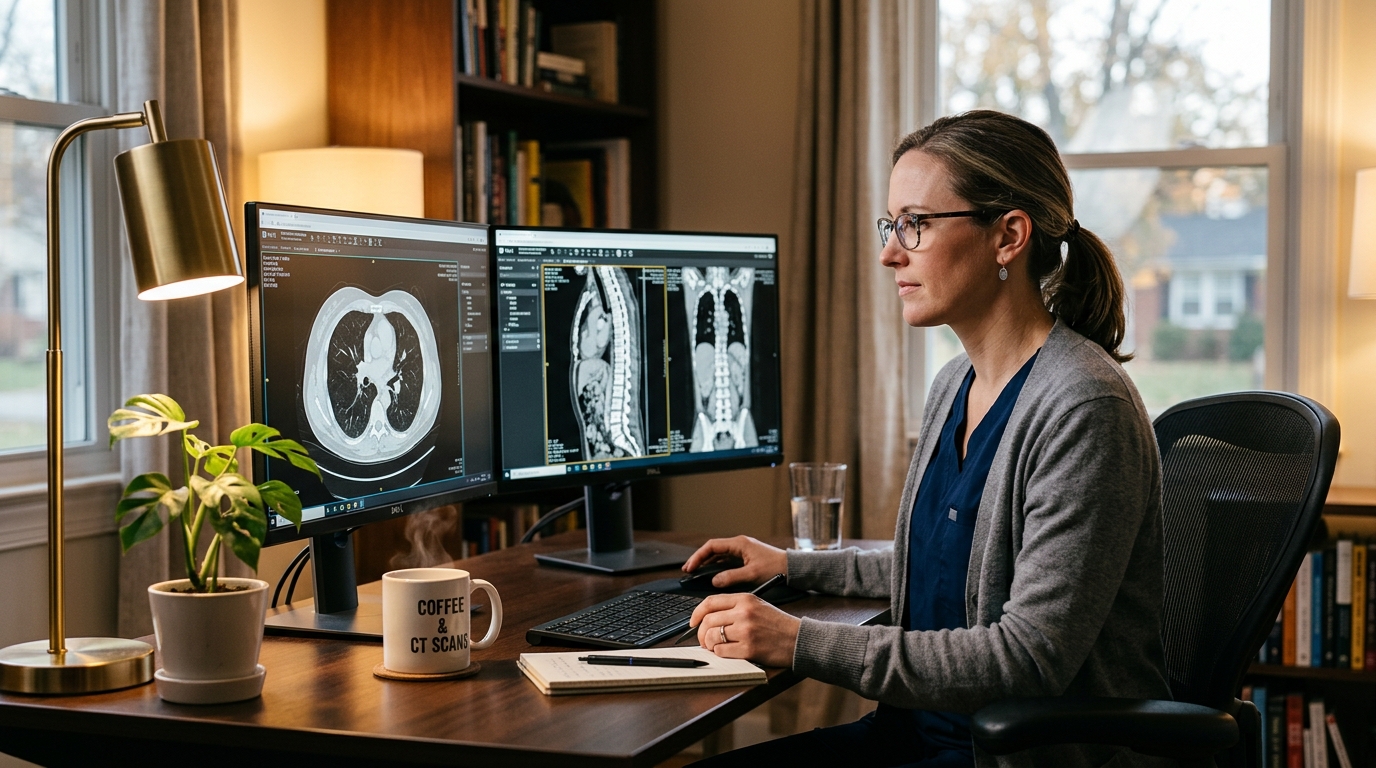
Last month, I had a coaching call with a CT tech named Mark who'd spent two hours scrolling through remote job postings claiming he could do his work from home. He was excited. He was also completely confused about what was actually possible.
"Jennifer," he said, "I found a posting for a 'remote CT technologist' making $70K. How do I apply?"
That's when I had to give him the honest answer: that job doesn't exist in the way he's imagining it.
The remote work revolution has hit every industry, including healthcare. And the radiology and imaging field is following that trend—just not in the way most technologists expect. After sixteen years working as an MRI tech and now coaching dozens of imaging professionals through career transitions, I've gotten really clear on what's actually available versus what's marketing hype.
Let me break it down for you.
What Remote Radiology Work Actually Exists
First, let's acknowledge that remote work in radiology is real. It just looks different than you might think.
Remote Radiologist Positions (Not for Techs)
Remote radiologists reading studies from home—that's the biggest trend. Teleradiology companies like Radiology Partners, vRad, and others employ radiologists who interpret studies from home. But here's the thing: that's not a job for technologists. That's a physician-level role.
Radiologists have twelve years of training, board certification, and legal licensing that makes remote reading possible. A tech looking for remote opportunities needs to understand that this isn't their pathway. I mention it because so many techs see these postings and wonder if they're missing something. You're not.
Remote PACS Administration
This is real and growing. PACS (Picture Archiving and Communication System) administration can absolutely be done remotely. A PACS admin manages the systems that store and distribute imaging studies—servers, software updates, user access, troubleshooting, data management.
This role typically requires some IT background plus imaging knowledge. The transition from a clinical tech to PACS admin usually means formal IT training or certification. Some facilities will train someone who has strong tech aptitude and imaging knowledge, but it's not automatic.
Salary range for remote PACS admin roles: $55K-$75K depending on experience and location.
Teleradiology Support and QA
This is where I'm seeing the most realistic remote opportunities for techs. Some teleradiology companies hire:
QA Specialists: Review studies for image quality, proper protocols, and study completeness before they go to radiologists. This can absolutely be done remotely with proper system access. You're looking at image quality—did the tech image the correct anatomy? Is the positioning acceptable? Are there artifacts?
Technical Support: Help remote radiologists troubleshoot PACS issues, software glitches, system access problems. This requires rad tech knowledge plus troubleshooting skills.
Study Coordinators: Manage workflow, track studies, communicate between techs and radiologists, troubleshoot routing issues.
I had a coaching client, Amy, who transitioned from being a mammography tech to a remote QA role with a teleradiology company. She kept her radiology knowledge but moved to a pure QA function. Year one, she made $52K remote. By year three, she was at $68K and training new QA staff. It's legitimate work.
Health IT and Vendor Roles
Companies that manufacture imaging equipment or health IT systems—GE, Siemens, Philips, Epic, etc.—hire imaging professionals for roles that are increasingly remote:
- Technical support for imaging modalities
- Implementation coordination
- Trainer roles (training other techs on new equipment)
- Documentation and quality assurance
These roles leverage your radiology knowledge without requiring on-site presence. A friend of mine, David, was a CT tech for fifteen years before moving to a vendor support role with a major equipment manufacturer. Now he works remotely, helping hospitals troubleshoot CT scanner issues. He earns $72K plus benefits.
What's Definitely Not Remote (No Matter What the Job Posting Says)
Let me be crystal clear because this is where the hype breaks down:
Clinical Radiology Tech Work
You cannot do an MRI exam from home. You cannot perform ultrasound from home. You cannot operate a CT scanner from home. You cannot take X-rays from home.
I see job postings occasionally that claim "remote MRI tech" or "work-from-home radiography." These are either:
- Mislabeled positions (they're actually PACS admin or QA)
- Scams
- Marketing confusion
If a posting says you can be a clinical "rad tech" working remotely, verify very carefully what the actual job description says. Often it's administrative or QA work, not clinical imaging.
Interventional Radiology Tech
Interventional radiology is high-touch, hands-on work. You're in the procedure room, managing catheters, prepping patients, operating fluoroscopy equipment. This absolutely requires your physical presence. Full stop.
Mammography and Breast Imaging
Another hands-on role. You need to be there to position the patient, explain procedures, operate the equipment. No remote alternative.
The Honest Assessment: Is Remote Radiology Work Realistic for You?
Here's what I tell my coaching clients:
If you're a clinical rad tech (MRI, CT, radiography, ultrasound, interventional, nuclear medicine), remote work isn't really in your immediate future unless you're willing to transition into a supporting role. That's not bad news—there are good opportunities in QA, PACS, and vendor roles—but it's a different job.
If you're specifically interested in remote work, you have a few realistic paths:
Path 1: Move into PACS/IT Administration (12-18 month transition)
- Requires additional IT training or certification
- Starting salary often lower than clinical work ($45-55K)
- Grows to $65-80K+ with experience
- Good for people who like problem-solving and systems thinking
Path 2: Transition to QA/Clinical Support (3-6 month transition)
- Leverages your clinical imaging knowledge
- Less hands-on, more analytical
- Salary competitive with clinical work ($52-70K)
- Remote from day one at companies like teleradiology firms
- Requires meticulous attention to detail
Path 3: Move to Healthcare IT/Vendor Roles (6-12 month transition)
- Often requires some additional training or certifications
- Better long-term earning potential ($65-90K+)
- More competitive field
- Values your imaging background plus your willingness to learn systems
Path 4: Stay Clinical, Get Flexible Scheduling
- Most realistic option if you love clinical work
- Many outpatient centers offer 100% daytime schedules
- Some support part-time remote opportunities for administrative duties
- Keeps your core skills sharp
Red Flags for Remote Radiology Job Postings
After sixteen years in this field and three years coaching others through it, I've learned to spot the suspicious ones:
- Claims clinical techs can work remotely full-time. Not realistic.
- Vague job descriptions that mix clinical and administrative work. Ask for clarification.
- Unusually high pay for remote-first radiology positions. If it sounds too good to be true, it probably is.
- Companies you've never heard of requiring upfront payments or certifications. Red flag.
- No mention of specific systems or workflows. Legitimate QA/admin roles will talk specifics.
What I'm Actually Seeing in 2026
The remote radiology job market is growing, but it's not where most techs imagine it. Here's what's genuinely expanding:
Teleradiology companies are hiring more support staff, QA specialists, and workflow coordinators. These are real jobs that are 100% remote.
Health systems are creating hybrid remote roles where techs handle administrative imaging work remotely (scheduling, quality checks, protocol compliance) a few days a week while maintaining on-site clinical presence.
Vendor and equipment companies are expanding their remote support teams because they can hire the best talent nationwide.
Home health and portable imaging networks are growing, which means more techs managing schedules, coordinating logistics, and handling QA remotely.
My Bottom Line for You
If you're a rad tech considering remote work, be honest about what you're optimizing for. If it's:
- Flexibility + keeping clinical skills: Look for hybrid outpatient centers or part-time arrangements
- Pure remote work + using imaging knowledge: PACS, QA, or vendor support are your realistic paths
- Better work-life balance: You might not need remote work—a daytime-only, Monday-Friday outpatient position might solve your actual problem
The remote radiology job market is real and growing, but it's not a one-to-one replacement for clinical work. It's a different path that builds on your foundation.
Understand that difference, and you'll make a much smarter career decision.
Related Articles

Burned Out as a Rad Tech? Here's How to Reignite Your Career
April 23, 2026

Managing Up: How Rad Techs Can Influence Department Decisions
April 22, 2026

How to Compete With Travel Agency Pay Without Breaking Your Budget
April 22, 2026
Quality Assurance in Radiology: Why QA Culture Affects Retention
April 21, 2026