How to Start a Rad Tech Program Advisory Committee
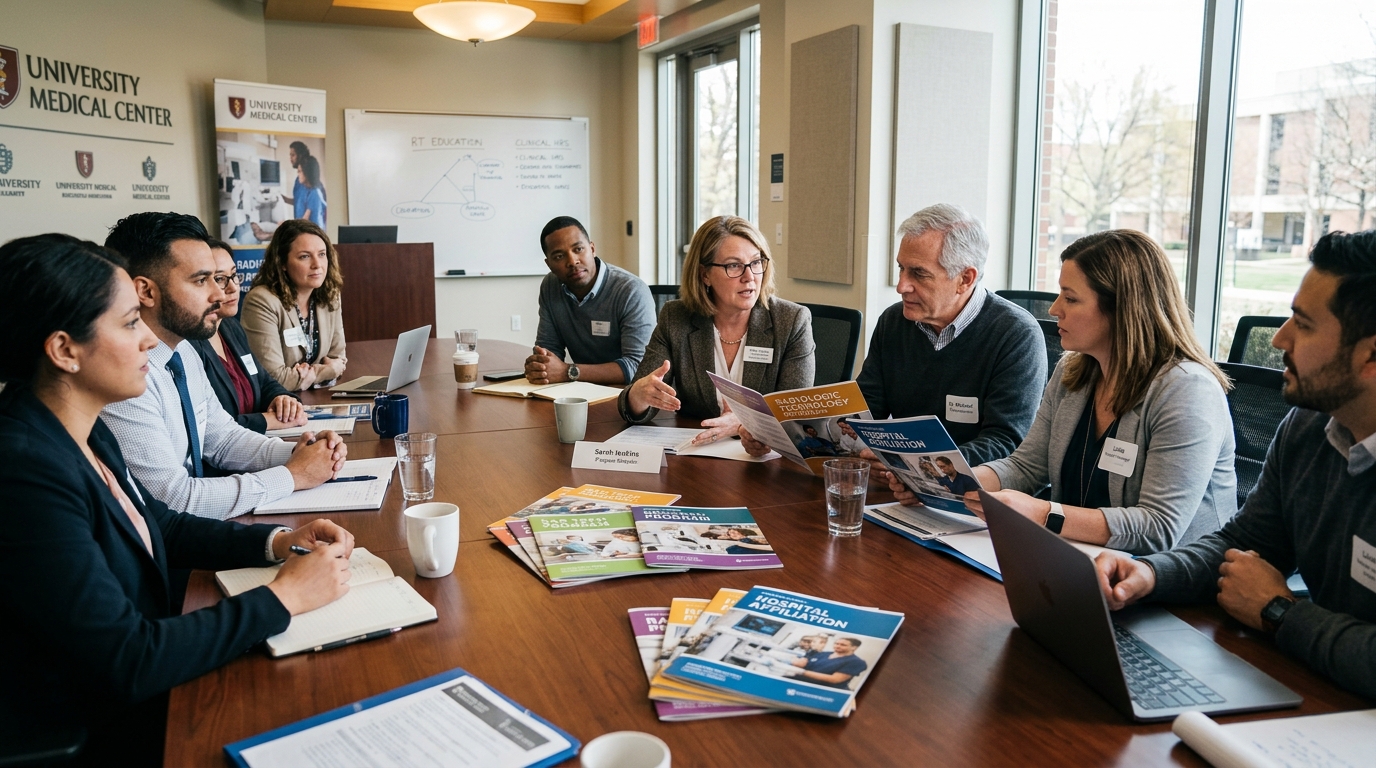
I was on my third contract as a travel radiology technologist when I got the call that changed my career trajectory. The community college running the radiologic science program in my home area was looking for clinical advisors. Would I be interested in serving on their program advisory committee?
At the time, I'd seen the problem firsthand. I'd trained dozens of new technologists coming straight from programs, and the mismatch was striking. Students arrived with textbook knowledge of principles but often lacked practical problem-solving skills. They knew theory but not workflow. They could recite positioning from a manual but hadn't dealt with a real human who couldn't cooperate with positioning.
I agreed to join, assuming it would be a couple of meetings a year. Turns out, being on an advisory committee for a radiologic science program is one of the most impactful things I've done for the profession.
Here's what advisory committees are, why they matter, and how to start one if you're in a position to do so.
What an Advisory Committee Actually Does
A program advisory committee bridges the gap between educational institutions and clinical practice. It's literally the mechanism that keeps training programs grounded in what the profession actually needs.
The committee reviews and advises on:
- Curriculum design – making sure what's being taught matches clinical reality
- Equipment and technology – ensuring students learn on equipment they'll encounter in practice
- Clinical rotation placements – coordinating where students get their hands-on training
- Emerging modalities – integrating new technologies into the program
- Industry workforce needs – communicating to educators what skills employers actually need
- Student preparation – identifying gaps between program output and clinical readiness
Most schools are required to have advisory committees for accreditation purposes. But the quality and effectiveness of those committees varies wildly. Some are rubber-stamp operations where industry folks show up twice a year and agree with whatever the director suggests. Others are genuinely engaged partnerships that drive continuous improvement.
The good ones look like this: a mix of experienced clinical technologists, educators, imaging directors, and program faculty meeting quarterly to discuss real, specific challenges. "We're seeing new graduates struggle with quality assurance documentation." "We need to cover more mammography basics because employers are looking for cross-trained techs." "The newest CT scanners require different positioning than what the old equipment teaches."
Then the program actually changes based on that input.
Why This Matters (Especially Right Now)
The radiology technologist shortage is making advisory committees more critical than ever.
Here's what's happening: training programs are struggling with inadequate clinical rotation sites, outdated equipment, and faculty who aren't current with clinical practice. Meanwhile, employers can't find qualified graduates coming out of programs. There's a vacuum in between.
Advisory committees fill that vacuum. When a clinical educator like me sits on a program advisory committee and says, "We're hiring new MRI technologists and they all need basic mammography cross-training to be competitive," that information flows back to the program. If the program is responsive, they can adjust the curriculum.
When an imaging director contributes labor market data showing that experienced radiologic technologists with quality assurance or education credentials are more competitive than general techs, the program can start offering electives in those areas.
When an experienced CT tech describes the workflow challenges on modern interventional radiology suites, the program can build that into simulation training.
Advisory committees are the mechanism that keeps training programs producing graduates employers actually want to hire.
Who Should Be on the Committee?
A functional advisory committee needs diversity of perspective and experience. You want:
Clinical practitioners: Experienced radiologic technologists from different modalities (CT, MRI, nuclear medicine, ultrasound, interventional radiology, mammography). These are your frontline folks who see new graduates in action.
Educators: People who've transitioned from clinical practice into education, like I have. We understand both sides—what it's like to practice and what it takes to teach.
Department leadership: Imaging directors, QA leads, or clinical managers. These folks understand workforce planning, hiring challenges, and strategic needs.
School faculty: The program director and faculty representatives. They understand accreditation requirements, budget constraints, and pedagogical considerations.
Maybe one allied profession rep: A diagnostic sonographer or other imaging-adjacent professional can provide useful cross-functional perspective.
Ideally, diversity: In terms of geography, practice setting (small rural hospital vs. large urban medical center), and background. Programs serving a rural area need different preparation than programs in major metropolitan areas.
Avoid stacking the committee with one institution's representatives. If 60% of your committee members work at the same large hospital, you're not getting representative input.
How to Actually Start One (Step by Step)
If you're at a hospital or clinical site and there's a local radiologic science program, here's how to propose starting or strengthening an advisory committee:
Step 1: Talk to the program director. "I've been thinking about how our facility could better support your students and program. Have you considered a formal advisory committee?" Most program directors are thrilled to hear this. It shows clinical support and makes their job easier.
Step 2: Gauge interest at your facility. Talk to your imaging director, a few experienced techs, maybe an educator. You're looking for 3-4 internal folks who'd be willing to commit a few hours per year.
Step 3: Coordinate with the program. Work with the director to identify other clinical sites and practitioners who might participate. They may already have existing relationships with clinicians in the area. You're helping them formalize and structure what might be informal right now.
Step 4: Define the scope and schedule. What will the committee do? Most advisory committees meet quarterly (4 times per year), for 1.5-2 hours per meeting. Some add additional ad-hoc meetings for specific initiatives. Communicate this upfront so people understand the commitment.
Step 5: Prepare an agenda for the first meeting. Don't just wing it. Come with specific topics:
- Program overview and accreditation status
- Current curriculum and recent changes
- Known gaps or challenges
- Employer feedback on graduates
- Emerging needs (new technologies, workforce trends)
Step 6: Establish norms. This matters. Make clear that the committee is advisory (faculty makes final decisions, but input genuinely matters), that confidentiality applies (don't air program problems publicly), and that constructive input is expected.
What Your First Year Looks Like
The first year of an advisory committee is often about getting oriented and building relationships. Here's what usually happens:
Meeting 1: Introductions, program overview, tour of facilities Meeting 2: Deep dive on curriculum—what's taught, how it's taught, where feedback is needed Meeting 3: Clinical reality check—what are employers actually looking for, what challenges do new grads face Meeting 4: Planning for the next year, identifying specific areas for improvement
By year two, you're typically more action-oriented. You might be proposing curriculum modifications, identifying clinical rotation sites, or coordinating guest lectures from specialists.
The timeline for change varies. Some suggestions get implemented quickly. Others take time because they require budget approvals or major curriculum redesign.
Real Examples of Advisory Committee Impact
Let me give you specific examples of what I've seen work:
Example 1: Our local program was teaching interventional radiology as a "nice to know" elective. But two hospitals in the area were actively hiring IR-trained techs. The advisory committee brought this labor market data to the faculty. Now IR is integrated into the main curriculum, and graduates are more competitive.
Example 2: The program had one older MRI scanner for training. Advisory committee members coordinated to allow student rotations at three local hospitals with newer equipment. Students now graduate with exposure to current technology they'll actually encounter.
Example 3: Faculty weren't current with quality assurance practices. An advisory committee member who teaches QA offered to lead a professional development session for faculty. Now QA is integrated more thoroughly into the curriculum.
Example 4: The program received funding for a simulation lab. Advisory committee provided input on which equipment to prioritize. They chose equipment matching what hospitals in the region actually use.
These aren't massive changes. But they're the difference between a program that stays connected to clinical reality and one that drifts into academic theory.
Why You Should Care (Even if You're Not in Education)
If you're an experienced radiology technologist who cares about the profession's future, this matters.
The radiology technologist shortage is real partly because training programs aren't producing enough graduates. But it's also real because some programs aren't producing graduates who are immediately practice-ready. Advisory committees help close that gap.
When programs are connected to clinical practitioners, they produce better-prepared graduates. Those graduates stay in the field longer because they're not shocked by the difference between training and practice. They're more confident. They advance faster. They contribute better to the profession.
And from a selfish perspective: if you're at a facility struggling to find qualified new technologists, supporting the local training program through an advisory committee is a direct investment in your facility's future workforce.
The Time Commitment (It's Not As Bad As You Think)
Most advisory committee members commit about 6-8 hours per year. That's typically 4 quarterly meetings of 1.5-2 hours, maybe a tour or guest lecture. It's not a huge commitment.
And honestly? It's interesting work. You get to shape the future of the profession at a local level. You see what's coming into the field and get to influence how they're prepared. And you contribute to solving the workforce shortage that's affecting your own work.
The Bottom Line
If you're in radiology—whether as a practitioner, educator, or director—you should know about advisory committees and consider getting involved. They're the mechanism that keeps training programs relevant and connected to clinical practice.
The radiology technologist shortage isn't getting solved by accident. It's getting solved by people who care enough about the profession to invest time in it. Advisory committees are one of the most direct ways to do that.
If your local program doesn't have an active advisory committee, reach out to the director. If you're ready to lead, even better. This is how we build a stronger pipeline of better-prepared radiologic technologists for the field.
Related Articles

Burned Out as a Rad Tech? Here's How to Reignite Your Career
April 23, 2026

Managing Up: How Rad Techs Can Influence Department Decisions
April 22, 2026

How to Compete With Travel Agency Pay Without Breaking Your Budget
April 22, 2026
Quality Assurance in Radiology: Why QA Culture Affects Retention
April 21, 2026