Nuclear Medicine Technology: The Overlooked Specialty With Incredible Growth
When I tell people I'm a nuclear medicine technologist, they often give me a blank stare. "So, like... radioactive stuff?" they ask hesitantly. Then, when I explain what I actually do, their eyes light up—and they usually say something like, "Why doesn't anyone talk about this?"
That's exactly why I'm writing this post. After a decade working in nuclear medicine, I've watched colleagues in CT, MRI, and ultrasound get far more recognition and recruitment attention, while our department stays chronically understaffed. Meanwhile, we're experiencing unprecedented growth, commanding competitive salaries, and doing some of the most fascinating work in medical imaging. Nuclear medicine isn't just overlooked—it's radiology's best-kept secret.
If you're considering a radiology tech career or looking to specialize, this is the post that might just change your trajectory.
What Nuclear Medicine Actually Is (And Why It's Different)
Most people associate radiology with anatomy: the X-rays that show your broken bone, the CT that visualizes your organs, the MRI that maps your brain. Nuclear medicine is the outlier. We don't primarily image anatomy—we image function.
Here's the fundamental difference: when you get an X-ray or CT scan, radiation passes through your body and we capture what bounces back or gets absorbed. In nuclear medicine, we inject you with a radiopharmaceutical—a radioactive tracer bound to a biologically active compound—and then we image the tracer itself as it accumulates in your body, travels through your bloodstream, or binds to specific tissues and organs.
This means we can literally watch your heart pump, see blood flow to your brain in real time, detect bone metastases before they show up on any other imaging modality, or identify infections and inflammation that haven't yet caused structural damage. We're visualizing the earliest signs of disease—sometimes years before anatomy changes.
That's the magic of functional imaging, and it's why nuclear medicine is absolutely irreplaceable in modern medicine.
The Daily Reality: What A Nuclear Medicine Tech Actually Does
On any given shift, my day involves multiple roles that most other rad techs never touch. I'm part nuclear pharmacist, part technician, part nurse, and part quality control specialist.
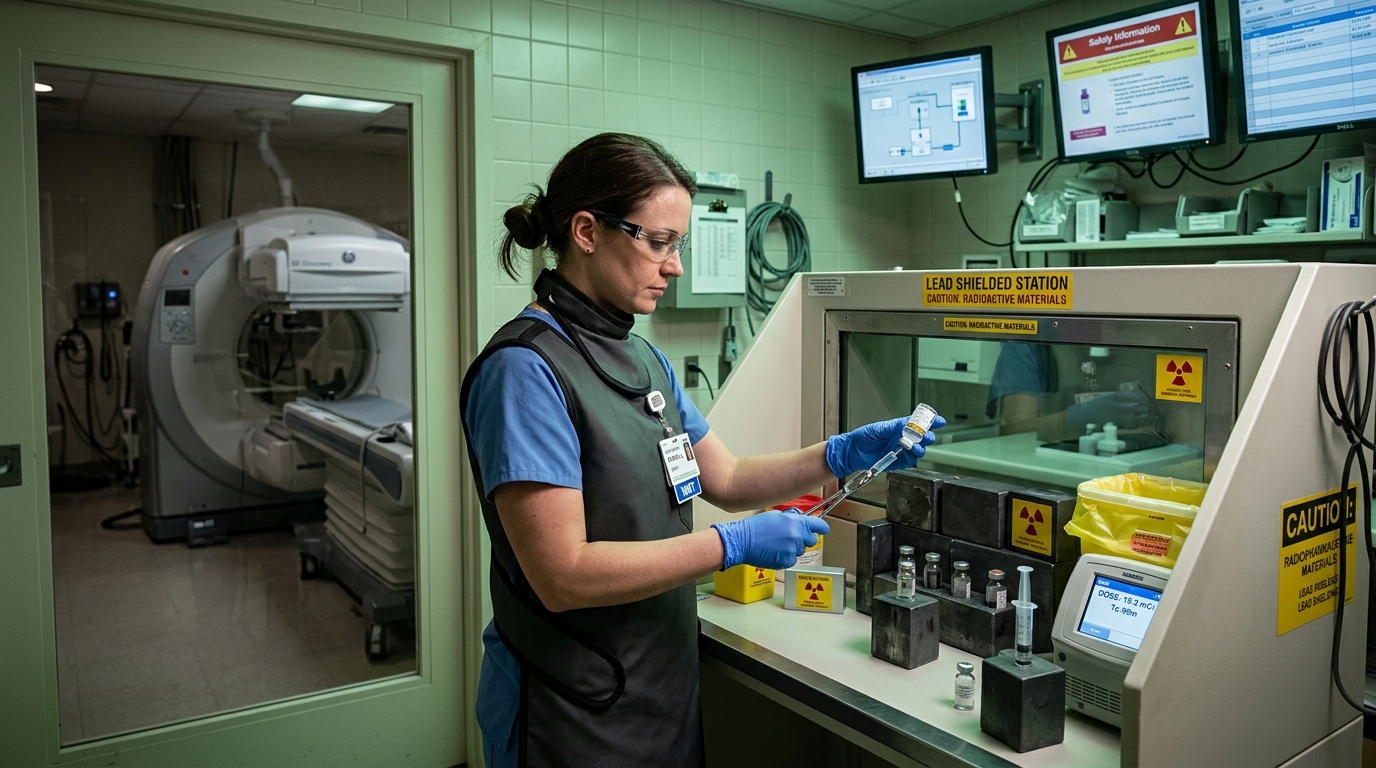
The morning usually starts in the hot lab—a lead-lined room where I prepare radiopharmaceuticals. This is precise, hands-on work. I'm measuring doses using calibrated equipment, calculating decay corrections, quality-checking radiochemical purity, and preparing syringes with radioactive material. It requires serious attention to detail and solid math skills, but it's genuinely satisfying to know the exact dose a patient receives is calculated with extreme precision.
Then I move to the imaging floor. I'm greeting patients, explaining what we're doing (which takes longer than in other modalities because most people have never had nuclear medicine), establishing IVs, injecting tracers, and positioning patients under gamma cameras or PET scanners. But here's what's different from other imaging: I'm often building rapport and staying involved throughout the imaging process. A cardiac stress test nuclear protocol might take two hours from start to finish—and I'm there managing that entire patient journey.
I'm also troubleshooting equipment, maintaining imaging protocols, understanding the science of what we're imaging well enough to recognize when something looks wrong, and collaborating closely with the radiologist and cardiologist on clinical findings. It's intellectually engaging work that demands both technical precision and clinical judgment.
The Science That Makes It Fascinating: Radiopharmaceuticals and Hybrid Imaging
If you liked chemistry and biology in school, nuclear medicine will satisfy that intellectual hunger in ways other imaging modalities might not.
Every radiopharmaceutical is essentially a molecular puzzle: you're taking a radioactive isotope (Technetium-99m, Fluorine-18, Iodine-131, or others) and attaching it to something that will accumulate where disease exists. A bone scan tracer attaches to compounds that bind to osteoblast activity. A myocardial perfusion agent mimics potassium and concentrates in viable cardiac tissue. A PET tracer labeled with glucose follows metabolic activity.
This is functional medicine at its most elegant. You're not waiting for a tumor to grow large enough to distort anatomy—you're detecting it through its metabolic behavior.
The future of nuclear medicine is exploding with hybrid imaging technology. PET/CT combines PET's functional information with CT's anatomical precision. PET/MRI is emerging and offers extraordinary soft tissue detail alongside metabolic data. SPECT/CT gives us three-dimensional functional-anatomical fusion. These hybrid modalities are redefining how we diagnose and stage cancer, evaluate cardiac viability, and detect neurodegeneration.
Working in hybrid imaging is like being part of the cutting edge of radiology—because we are.
The Job Market Reality: Demand That Actually Exceeds Supply
Here's the uncomfortable truth: nuclear medicine is severely understaffed.
While other imaging specialties have adjusted to staffing levels and developed recruitment patterns, nuclear medicine continues to experience persistent, genuine shortages. Many departments are operating at 60-80% of ideal staffing. Positions stay open for months. Travel contracts command premium rates. Overtime is constant.
Why? Most imaging programs don't emphasize nuclear medicine during training. Students gravitate toward the modalities that get classroom time and clinical emphasis. Additionally, nuclear medicine has a steeper learning curve than some other specialties—you're managing radioactivity, understanding complex pharmacology, and working with expensive equipment. That higher barrier to entry means fewer techs are competing for positions.
For you as a job seeker, this translates to exceptional leverage. You'll have multiple offers. You can be selective about geography, institution type, and work environment. Departments are actively recruiting and willing to invest in training and development because they need you.
Salary and Compensation: Competitive and Growing
Nuclear medicine technologists consistently earn among the highest salaries in radiology technology. According to recent Bureau of Labor Statistics data and job board analysis, nuclear medicine techs earn an average of $75,000-$85,000 annually, with experienced techs in urban markets reaching $95,000+.
This compares favorably to radiography ($65,000-$75,000), ultrasound ($68,000-$78,000), and MRI ($70,000-$82,000). The demand-supply imbalance means salaries continue climbing. I've also observed that nuclear medicine departments are more likely to invest in continuing education, certification advancement, and professional development—which increases earning potential further.
Many departments also offer shift differentials, overtime premiums, and call-back pay that other modalities don't. The actual take-home compensation often exceeds published salary ranges once you factor in these benefits.
The Radiation Misconception: Safety Wins Over Sensation
Let me address the elephant in the room: "Aren't you exposed to dangerous radiation?"
The short answer is no, not in any concerning way. Our radiation safety protocols are rigorous, science-based, and heavily regulated by the NRC. We use lead-lined aprons, lead vests, thyroid shields, lead-lined syringe shields, and maintain proper distance and time principles. Radiation exposure is continuously monitored with dosimetry badges.
Here's the reality that surprised me as a new tech: my annual occupational dose is typically 0.5-1.0 mSv. The average American receives about 3 mSv annually just from background radiation. Living in a stone or brick building or flying frequently exposes you to more radiation than working in nuclear medicine with proper safety practices.
We take it seriously—as we should—but radiation is a tool we understand and manage safely. The anxiety around it usually exceeds the actual risk by a significant margin. If you're willing to follow protocols (and good nuclear medicine programs make this non-negotiable), your safety is excellent.
Certification Pathways and Professional Advancement
There are two primary certification routes: the NMTCB (Nuclear Medicine Technology Certification Board) exam and the ARRT (American Registry of Radiologic Technologists) NMTCB certification. Both require an accredited education program plus clinical experience.
Here's what excites me about nuclear medicine as a career path: there's clear advancement opportunity. You can specialize in PET imaging, cardiac imaging, or thyroid imaging. Many techs pursue management roles—our specialized knowledge is valuable for directing departments and training staff. Some advance into physics roles or vendor positions. Others explore therapeutic nuclear medicine, where you administer radioactive treatments for thyroid cancer and other conditions.
I've also seen techs leverage their nuclear medicine background to pursue nuclear pharmacy, health physics, or even entrepreneurial directions in radiopharmaceutical production. The skills are portable and respected.
Why I Chose Nuclear Medicine, and Why I'm Staying
Ten years ago, I was a fresh X-ray tech considering my options. I'd taken a clinical rotation in nuclear medicine almost by accident—it wasn't my first choice. I was immediately hooked. The intellectual engagement was different. The patients were more involved in their care. The technology fascinated me.
But what's kept me here is the culture. Because nuclear medicine departments are smaller and more specialized, there's a genuine teamwork dynamic. You know your colleagues deeply. You're invested in each other's success. The knowledge transfer is real—experienced techs genuinely mentor newer staff because you're all managing the same complex work.
I've also stayed because of growth. This specialty has evolved dramatically in my ten years. New tracers, new applications, new hybrid technologies—the field keeps demanding that we learn and adapt. That intellectual stimulation matters to me more than I expected.
And honestly? The job security is excellent. Nuclear medicine isn't going away. It's growing. Demand outpaces supply, and that asymmetry protects your career in ways that other specialties might not.
The Overlooked Specialty That Shouldn't Be
Nuclear medicine technology offers everything you might want from a radiology career: competitive compensation, genuine job security, intellectual engagement, advancement opportunity, and work that matters clinically. Yet it remains overlooked, undersold, and underrepresented in most training programs.
If you're someone who enjoys science, wants to make a real impact on patient care, doesn't mind working at the intersection of multiple disciplines, and values a career with genuine demand and growth potential—nuclear medicine deserves serious consideration.
The field needs passionate, capable technologists. And I genuinely believe you'd find the work as rewarding as I have.
Ready to explore nuclear medicine opportunities? RT Job Bank has dedicated listings for nuclear medicine technologists. Browse current positions in your region, compare compensation packages, and connect with departments that are actively recruiting. Your dream nuc med role might be just a few clicks away.
Related Articles

Burned Out as a Rad Tech? Here's How to Reignite Your Career
April 23, 2026
Managing Up: How Rad Techs Can Influence Department Decisions
April 22, 2026

How to Compete With Travel Agency Pay Without Breaking Your Budget
April 22, 2026
Quality Assurance in Radiology: Why QA Culture Affects Retention
April 21, 2026