How AI Is Changing Radiology — And What It Means for Hiring
I've been a radiology technologist for fifteen years. I started when PACS was still relatively new, watched digital mammography replace film, and transitioned from fluoroscopy to digital radiography. I've seen AI hype before. I'm skeptical. But this is different.
AI in radiology is actually happening. It's not coming—it's here. And unlike the doomsday headlines, it's not replacing rad techs. It's changing what we do, though. If you want to understand what your career looks like over the next decade, I think it's worth looking at this honestly.
The Reality of AI in Radiology Right Now
Let me be clear about what's actually deployed and what's vaporware. There's a lot of hype in both directions—tech companies overselling "revolutionary AI" and radiologists underselling "just a computerized second read." The truth is somewhere in the middle.
Right now, most AI in radiology does three main things:
It detects certain findings with reasonable accuracy. There are FDA-cleared systems for breast density assessment, lung nodule detection, and bone age determination. These work. They're not perfect—no AI system is—but they're legitimate tools. Some hospitals are using them. Many aren't yet.
It helps with workflow optimization. Some PACS and RIS systems now have AI-assisted protocol recommendations. Instead of manually selecting chest X-ray protocols from a dropdown, the system suggests the right protocol based on the order and clinical history. It's a small thing, but it saves time and reduces errors.
It handles some administrative tasks. Automated worklist prioritization is becoming more common. The system learns which cases are urgent based on radiology reports and patient factors, then optimizes the reading queue. This is less "replacing techs" and more "helping the department run smoother."
What AI is not doing—what it's nowhere near doing—is replacing the actual technical skill of operating imaging equipment. That's the important part to understand.
The Skills That Matter Most
Here's something I tell younger techs all the time: the technical skills you develop—how to position patients, how to adjust exposure factors, how to get diagnostic quality images—those are still critical. Maybe more critical.
Why? Because as AI handles more routine analysis, the value of getting the image right the first time goes up. When you had a radiologist looking at every chest X-ray anyway, a slightly suboptimal image might get flagged. Now, if the AI system is doing some of the analysis, a poorly positioned or noisy image might confuse the system. The technical foundation matters more, not less.
But here's what's changed: the job is expanding, not contracting. Let me explain.
When I started, rad techs did one thing: acquired images. We got the patient positioned, adjusted technique, took the image, sent it to PACS. Done. The radiologist took it from there. Clear separation of duties.
Now? The best rad techs I work with understand protocol optimization. They know why we're adjusting dose on that CT. They understand why we're using contrast in certain cases. They can troubleshoot when an ultrasound looks weird. They know the basics of the AI system they're working alongside—what it's designed to detect, what its limitations are, how to flag cases where it might struggle.
This isn't complicated stuff, but it requires understanding the "why," not just the "how." And it means your value doesn't come from clicking buttons the same way every day. It comes from knowing how to problem-solve when things aren't routine.
What I'm Actually Seeing Happen
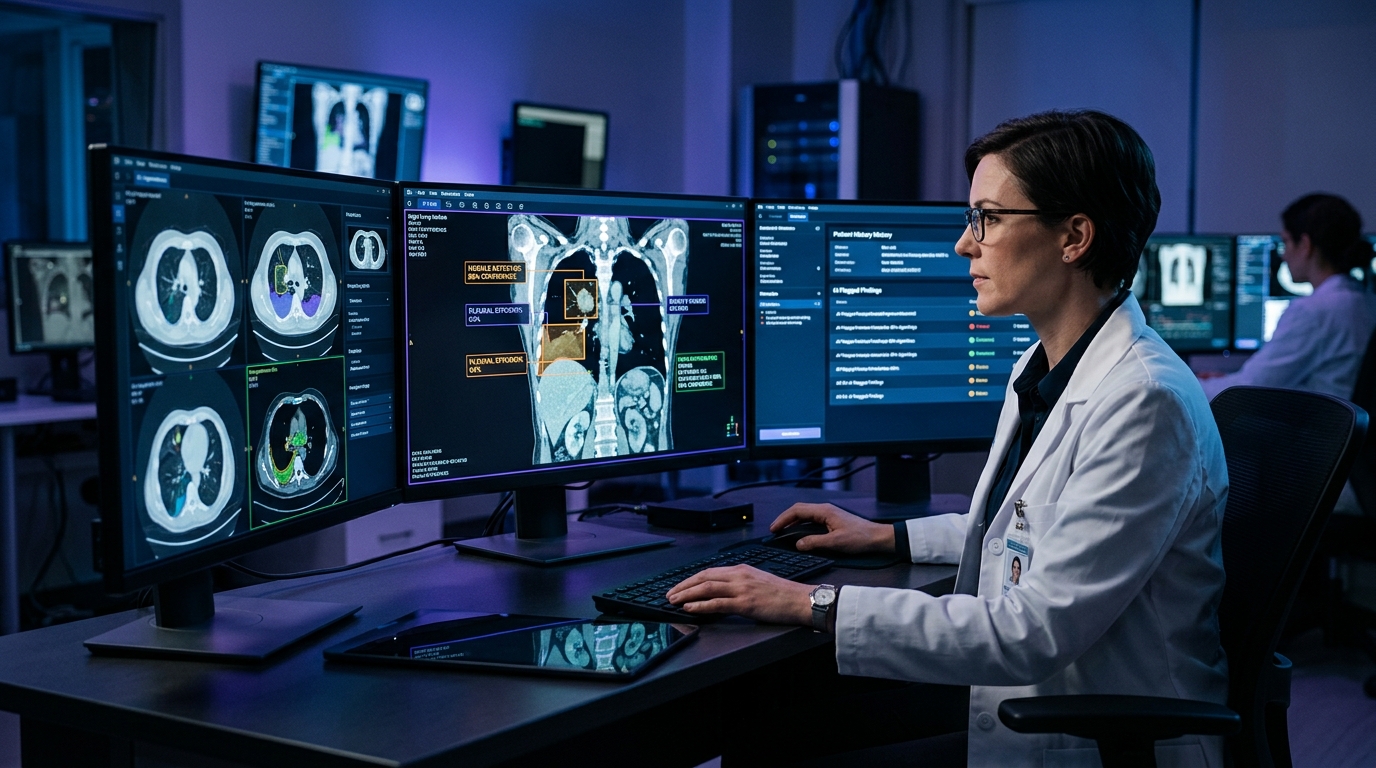
Let me walk you through a real scenario from my hospital. We just implemented an AI-assisted chest X-ray detection system for pneumonia and thoracic pathology.
Our radiologists can now see a "confidence score" for certain findings while they're reading. This doesn't replace their interpretation—they're still reading the case. But it works kind of like a sophisticated spell-checker. It'll flag things they might've missed, especially on busy nights. It catches real stuff that would've been missed.
From a technologist standpoint? A few things changed. First, image quality matters even more. The AI is very sensitive to motion artifact and poor positioning. A slightly blurry chest X-ray that a radiologist might've dealt with now makes the AI less reliable. So positioning standards became more rigorous.
Second, we needed training on the system. Not complicated training—an afternoon workshop. But understanding what it does, what it doesn't, and when to know it's giving weird results. One of our techs caught an AI error in the first week because she understood the system well enough to recognize an impossible confidence score for that patient's imaging history.
Third, we actually needed fewer radiologists reading nights. Not fewer people working—the radiologists moved to other duties, higher-level work, cases requiring more complex interpretation. But the workflow changed. And the techs needed to understand the new workflow to operate efficiently within it.
Where This Gets Interesting for Your Career
The honest assessment: some rad tech jobs will change more than others. Routine imaging shops—basic X-ray centers that do basic chest and extremity work—will see less impact. The job stays pretty similar. More technical settings with advanced imaging—hospitals with CT, MRI, interventional radiology, specialized imaging—will see bigger changes.
And here's the thing that most people get wrong: the bigger changes don't necessarily mean fewer jobs. They mean different jobs.
When imaging workflows become more complex, more automated, and more integrated with clinical systems, you need techs who understand that complexity. You need people who can operate in an environment where the imaging equipment talks to the PACS, which talks to the AI system, which generates reports that feed into the electronic health record. That's not less technical. It's more technical.
A hospital with fully integrated AI-enhanced imaging needs rad techs with deeper knowledge. Not necessarily longer training—but deeper understanding of how systems work together. That's a problem to solve, but it's not an existential threat to the profession.
The jobs that are actually vulnerable aren't being eliminated by AI. They're being eliminated by consolidation. Mobile X-ray centers being absorbed into hospital networks. Free-standing imaging centers losing volume to bigger competitors. Those shifts have way more to do with business strategy than technology.
What Rad Techs Should Actually Be Doing Right Now
If you're concerned about your career over the next decade, here's what I think matters:
Stay technically current. Don't let yourself get stale. If your hospital implements a new imaging modality, jump on it. If you can, pursue additional certifications. CT, MRI, mammography, ultrasound—whatever interests you. Broader skill sets are more valuable in a changing landscape.
Understand your equipment and systems. Not just how to use them—why they work. When you understand the physics of MRI or the purpose of dose optimization in CT, you're operating at a different level than someone just executing protocols.
Develop the communication skills you'll need in a team with AI. This sounds weird, but it matters. As systems get more complex, communication between techs, radiologists, IT, and yes, AI systems, becomes critical. The rad techs who thrive are the ones who can explain clearly what they saw, why they positioned a patient a certain way, or what went wrong with a scan.
Stay curious about how the profession is evolving. Read about new technology. Attend webinars. Join professional organizations where you'll see what's coming. The techs who get blindsided are the ones who ignore industry changes. The ones who adapt are the ones who watch what's happening and adjust accordingly.
The Honest Take
AI is going to change radiology. It'll change how we work, what systems we use, and what skills matter most. But it's not going to eliminate radiology technologists. Why? Because imaging requires human judgment and technical skill that AI can't replicate. Someone has to acquire the image, position the patient, troubleshoot equipment, and make clinical decisions that AI can't make.
What it will do is shift which techs are most valuable. The ones who see themselves as equipment operators? They're more vulnerable. The ones who see themselves as imaging professionals who understand their field? They're going to be fine. More than fine. As technology gets more complex, deeper knowledge becomes more valuable.
I've been in this field long enough to see multiple waves of technological change. Every time, there's panic about what will be lost. And every time, the profession adapts and actually expands. Radiologists worried digital would replace film. PACS worried about film readers becoming obsolete. Then interventional radiology created new specialties. Then advanced imaging created more roles.
This is just the next wave. And like the others, it'll create opportunities for people who stay engaged and keep learning.
That's not speculation. It's what I've actually seen happen.
Related Articles

Burned Out as a Rad Tech? Here's How to Reignite Your Career
April 23, 2026
Managing Up: How Rad Techs Can Influence Department Decisions
April 22, 2026

How to Compete With Travel Agency Pay Without Breaking Your Budget
April 22, 2026
Quality Assurance in Radiology: Why QA Culture Affects Retention
April 21, 2026