Understanding the Rad Tech Pipeline: Why Programs Can't Keep Up
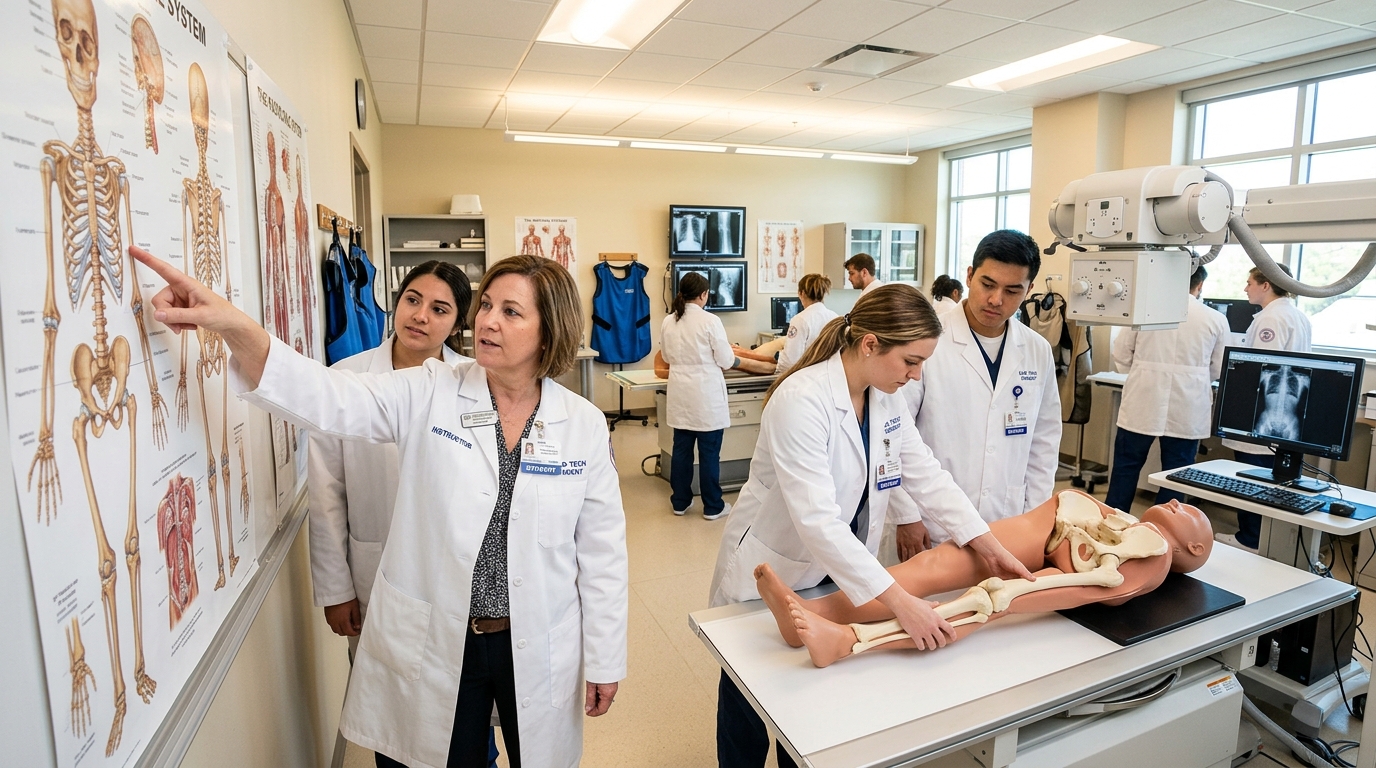
I started mentoring students about eight years ago. One of my former students had graduated and was struggling in their first job—imposter syndrome, typical new-grad stuff. They asked if I'd help. I said yes, and next thing I knew, I was getting calls from instructors at our local RT program asking if I'd take on more students.
That was 2018. There's been a shift every couple of years where more programs ask if I can mentor more students. The desperation has gotten more obvious.
Last year, I had this conversation with a program director at a school about two hours from where I work. She was frustrated. Her program graduated 24 radiologic technologists a year. The local hospital network needed probably 50. They couldn't expand because they didn't have clinical sites willing to take students. The program was at capacity for classroom instruction, but the bottleneck wasn't enrollment. It was clinical experience requirements.
That conversation stuck with me because it crystallized something I've watched for years: the rad tech shortage isn't just about people leaving the profession. It's about how few people are actually entering it in the first place.
And the bottleneck isn't where most people think it is.
The Numbers (And They're Worse Than You Probably Think)
Let me start with the macro picture. According to ARRT data, there are roughly 265,000 registered radiologic technologists in the United States. The Bureau of Labor Statistics projects demand for about 28,000 new rad techs through 2033. That's roughly 2,800 new techs needed annually.
How many are we graduating? Roughly 18,000 to 19,000 radiologic technologists yearly from accredited programs. That sounds like we're above demand, right?
Except we're not. Here's why: of those 18,000-19,000 graduates, not all of them stay in the field. Some go on to specialize (which removes them from general radiology supply). Some leave the profession within the first five years. Some go into education or administration (necessary, but they're not doing clinical imaging). And some move into specialized areas like nuclear medicine or sonography (again, necessary, but not replacing general radiology tech demand).
The actual supply of available, working radiologic technologists available for clinical imaging roles is lower than the demand. That's why you've got hospitals competing for the same pool of techs.
But here's the thing that really matters: we could be graduating more. We're not hitting a ceiling of how many people want to be radiologic technologists. We're hitting a ceiling of how many can actually get through the programs.
The Clinical Site Problem (The Real Bottleneck Nobody Talks About)
When you talk to RT program directors about expansion, the conversation always comes back to the same thing: clinical sites.
Here's how radiology tech education works: Students need classroom time (anatomy, physics, equipment, protocols). They also need clinical experience—actual time in real hospital imaging departments, performing real scans under supervision. Both are required by ARRT accreditation.
Classroom capacity is often not the limiting factor. A program can take more students in the classroom. But those students need clinical placements. And hospitals aren't obligated to take students.
Let me be very clear: I understand why hospitals are reluctant. Students slow down workflows. They require supervision from already-busy staff. They create liability. They're not productive. From a pure hospital operations perspective, having students is a cost center, not a revenue center.
But here's the problem: without students rotating through clinical sites, the pipeline dries up. And in five years, hospitals find themselves with even fewer technologists available, because there weren't enough students to graduate to fill the roles.
It's a classic short-term-thinking problem. Hospitals don't want to invest in education now, so they create a shortage later.
I've seen small hospitals opt out of clinical placements entirely. Mid-size hospitals cut their student placements to make room for travel techs (who are more immediately productive). Even larger hospitals, which you'd think would have capacity, are sometimes running lean enough that taking students feels impossible.
One program director told me she had capacity to train 40 students yearly but could only place 24 in clinical sites. That's a 40% reduction in graduates due to clinical placement availability, not because of classroom capacity or student demand.
That's the bottleneck. Not instruction. Clinical sites.
The Faculty Problem (And Why It's Getting Worse)
Here's something most clinicians don't think about: who teaches the next generation of radiologic technologists? Experienced radiologic technologists. People like me.
And right now, there's a career incentive problem.
If I stay clinical, I can make $65,000-$85,000 depending on my market and experience. If I move into education, I typically take a pay cut. Most RT education positions pay $55,000-$70,000. That's a real financial penalty for a skilled professional to move into education.
Beyond money, there's the lifestyle issue. Clinical work can be demanding, but you know what you're doing. Education is different. You're trying to prepare students for a profession that's in flux. You're managing students at different learning levels. You're dealing with program administration and accreditation requirements. It's harder in different ways.
So what happens? The best clinical techs don't move into education. Some do—people who are passionate about teaching, people who've burned out on clinical work, people who want a different pace. But it's not the majority.
And the current faculty is aging. A lot of the program directors and lead instructors came up in the 1980s and 1990s. They're near retirement. And programs are struggling to recruit younger techs into education positions.
This creates a staffing crisis for education itself. Programs can't expand because they don't have enough instructors. Good instructors are hard to find and hard to retain because the financial incentive isn't there.
I've been asked multiple times to go into education. Every time, I do the math, look at the pay, and decide I can't afford it. That probably means the program doesn't get the instructor they could have used. That probably means fewer students graduate. That probably means more shortage.
The Prerequisite and Curriculum Problem
Here's something else that's harder to see but really matters: getting into RT programs is getting harder.
Most accredited programs now require biology, chemistry, physics. Some require organic chemistry. They're also increasingly requiring higher GPAs for admission—competitive programs want 3.0 or higher.
That's not inherently bad. You want competent technologists. But it does narrow the applicant pool. Some bright people who'd make excellent technologists don't have the prerequisite grades or coursework.
And then there's the cost issue. Most RT programs run two years full-time. Prerequisite coursework is often an additional year. So you're looking at three years of education, tuition costs around $20,000-$40,000, and then you're starting a career at maybe $50,000 a year.
The ROI is reasonable, but the upfront barrier is real. Students from lower-income backgrounds might choose a shorter program with faster income potential. They might choose trade work. The pipeline loses them.
I mentored a student a couple of years ago who had incredible instincts for imaging. Really creative problem-solver. He didn't have the prerequisites to even apply. He was working construction and taking community college courses. By the time he'd have been eligible, he'd decided to finish his general contractor license instead. Different, shorter path. Lost a really talented potential technologist.
That's an anecdote, but it happens systemically.
The Specialization Split
Here's something I've watched happen: as the profession has advanced, more graduates are choosing specialized tracks instead of general radiology.
Nuclear medicine. MRI. CT. Sonography. Interventional radiology. These are awesome specialties. They're important. But they pull technologists out of the general radiology pool.
I'm not saying specialization is bad. It's necessary. But it's happening faster than we're replacing that supply with new general techs.
I came up in the 1990s and 2000s. Most of us did general radiography, and some of us moved into specialties. Now, students come into programs planning their specialty path from day one. That's great for them. It's less great for the general radiology supply problem.
And there's the nuclear medicine technologist track, which is actually a different credential path entirely. Some students go that direction instead of radiologic technology. Another split in the pipeline.
The Reality Check: What Gets Fixed?
So what actually solves this?
More clinical sites willing to take students. This is the single biggest thing. If hospitals committed to clinical placements—not as a cost center but as an investment in the workforce—program capacity would expand significantly.
Financial incentive for education faculty. RT education positions need to be competitive with clinical roles, or they need loan forgiveness, or they need some kind of incentive that makes the career move make sense.
Removal of unnecessary prerequisites. Look at whether every prerequisite actually predicts success in RT work, or whether some are just gatekeeping that narrows the applicant pool.
Investment in student scholarship/financial aid. Lower the barrier to entry, and more people can afford to pursue the education.
Expansion of online classroom components. Some programs are exploring hybrid models where classroom time is asynchronous or online, reducing the facility constraint. That could work, though clinical time has to be in-person.
But here's what I'm realistically seeing: these things happen slowly. There's no emergency-response mentality about the pipeline. Programs are doing what they can with constraints. Hospitals are making rational business decisions (students don't generate revenue). Techs like me are making rational career decisions (education pays less than clinical work).
The structure just doesn't incentivize the solution.
What Individual Departments Can Do
If you're a department manager or director and you're struggling with staffing, you can't solve the pipeline problem alone. But you can help.
Take students. Yes, it's a cost. Yes, it slows your team. But committing to clinical placements is an investment in future staffing. Better yet, partner with your local RT programs. Know who the good students are. Hire them when they graduate. Build pipeline relationships.
Hire newer graduates. You're probably going to hire travel techs for flexibility. But also hire and develop new graduates. They're your long-term workforce.
Support educators. If you hire techs who go into education, let them. Don't treat it as someone leaving your department. Treat it as someone expanding capacity in the pipeline. They'll remember it.
Mentor students. I mentor because I care about the profession. But also because I can. Not every tech can. But if you can spare 30 minutes with a student weekly, you're helping develop your future colleague.
The rad tech shortage is real. And yeah, it's because people are leaving and departments are burned out. But it's also because we're not producing enough new techs to meet demand. And that's a pipeline problem that needs structural solutions.
We can solve it. We're just not doing it yet.
Related Articles

Burned Out as a Rad Tech? Here's How to Reignite Your Career
April 23, 2026

Managing Up: How Rad Techs Can Influence Department Decisions
April 22, 2026

How to Compete With Travel Agency Pay Without Breaking Your Budget
April 22, 2026
Quality Assurance in Radiology: Why QA Culture Affects Retention
April 21, 2026