Radiation Therapy vs Diagnostic Radiology: Two Paths, One Passion
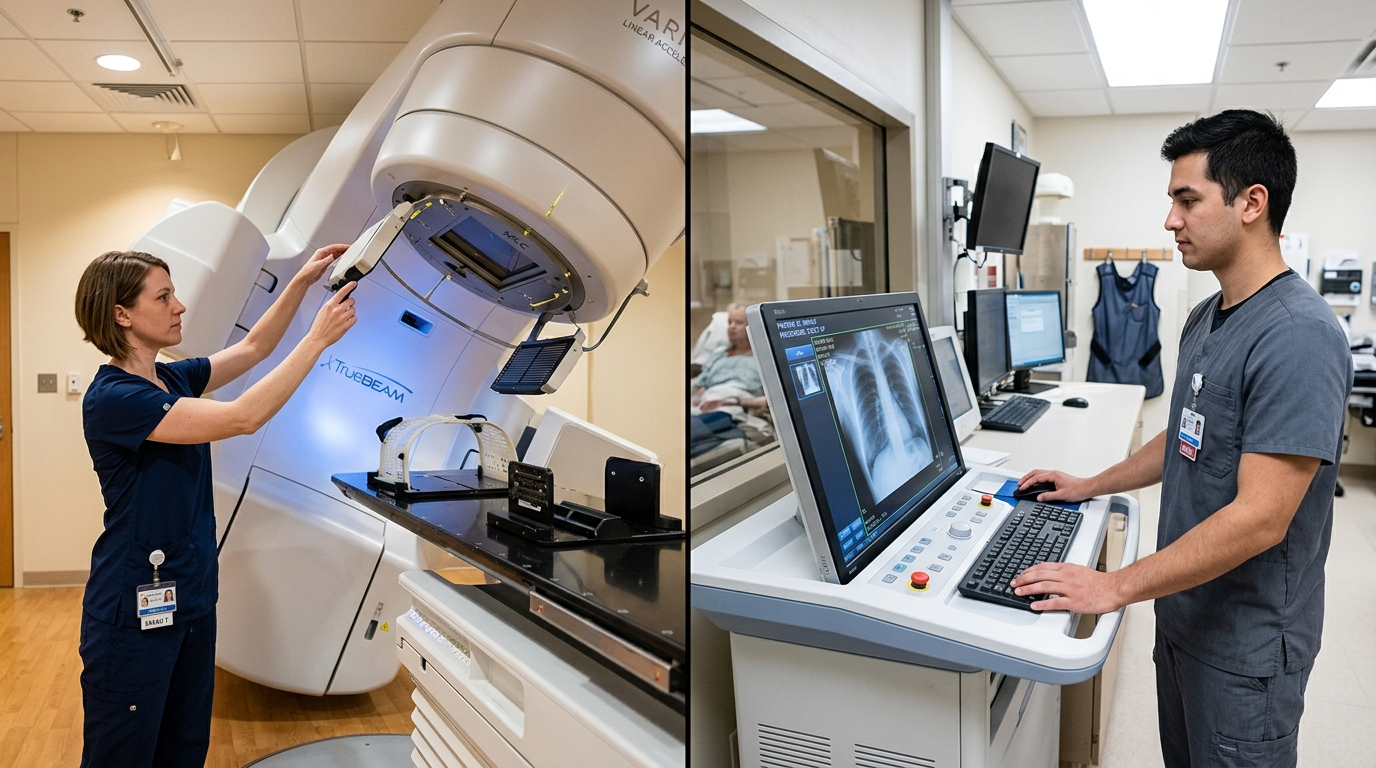
I get asked this question constantly: "Should I do radiation therapy or diagnostic radiology?"
As a nuclear medicine technologist with fifteen years in medical imaging, I've worked closely with both radiation therapists and diagnostic radiologists. I've scheduled patients with them, referred to them, collaborated on cases, and watched their careers unfold. I've also counseled dozens of students who were trying to decide which path to take.
Here's what I want you to know: these aren't just different specialties. They're fundamentally different jobs with different daily rhythms, different patient relationships, and different career trajectories. The fact that they both involve radiation doesn't make them interchangeable. Picking the wrong one for who you are could mean years of unhappiness in a field you thought you'd love.
Let me break this down honestly.
The Education Path
This is where the first major divergence happens.
Diagnostic Radiology Track:
To become a diagnostic radiologist—whether you're doing standard chest X-rays, CT scans, MRI, ultrasound, or nuclear medicine—you typically need:
- High school diploma or GED
- Some programs require prerequisite coursework (anatomy, physiology, sometimes chemistry)
- 2-year accredited radiologic technology program (AART)
- Pass the ARRT certification exam
- Total time to entry: typically 2-3 years
You can get licensed and working in about 2-3 years. Many people do this right out of high school with some prerequisites.
Radiation Therapy Track:
Radiation therapy has similar entry requirements but with a different emphasis:
- High school diploma or GED
- Prerequisite coursework (usually more rigorous—physics is often required)
- 2-year accredited radiation therapy program (AART)
- Pass the ARRT certification exam
- Total time to entry: typically 2-3 years
On paper, they look the same. In reality, radiation therapy prerequisites tend to be more physics-heavy. If you struggled with physics in high school, this is something to consider. I've seen brilliant techs who couldn't get through the physics requirement for rad therapy, and it frustrated them because they were otherwise well-suited for the work.
Daily Work: What You Actually Do
This is where things get really different.
Diagnostic Radiology
Your day involves:
- Scanning multiple patients across different modalities (or specializing in one)
- Managing patient flow and scheduling
- Operating imaging equipment
- Communicating with patients about procedures and what to expect
- Troubleshooting equipment issues
- Positioning patients for optimal imaging
- Possibly injecting contrast or other medications
- Collaborating with radiologists who interpret your images
You typically see 10-30 patients in a day depending on modality. Each interaction is relatively brief—maybe 5-20 minutes per patient. You're producing images that radiologists interpret, and you're not usually in the room when the diagnosis is delivered.
Radiation Therapy
Your day involves:
- Treating cancer patients with precisely targeted radiation
- Setting up treatment planning with radiologists and oncologists
- Precise patient positioning using lasers and imaging guidance
- Administering treatment using linear accelerators
- Monitoring patients during treatment
- Keeping meticulous records of doses and positioning
- Often seeing the same patients multiple times over weeks or months
You typically see 5-12 patients in a day, but you develop ongoing relationships with them. You're administering a therapeutic treatment, not just producing images for someone else to interpret. You're directly part of their cancer treatment plan, and you'll often know whether the treatment worked because you're seeing them through the entire course.
This is a crucial difference: diagnostic techs produce images. Radiation therapists deliver treatment.
Patient Interaction
This is something that really matters, and I think it's underestimated in career counseling.
Diagnostic Radiology
You interact with patients in moments of uncertainty and anxiety. They're coming for imaging because something's wrong—or they're worried something's wrong. Your job is to get them comfortable enough to stay still and not be scared. You explain what's going to happen. You answer their questions. You reassure them.
But it's often one encounter. Some patients you never see again. You don't usually know the outcome of their imaging.
I have colleagues in diagnostic radiology who've been doing this for twenty years and can't tell you a single patient success story because they don't follow outcomes. That's fine for some people. For others, it's emotionally unfulfilling.
Radiation Therapy
You develop genuine relationships with patients. They come to you 20-30 times over the course of their treatment. You see them at their most vulnerable. You watch their hair fall out, their energy decline, their hope fluctuate. You're not just a technologist—you become part of their support system.
When they finish treatment, you know them. Sometimes you hear back. Sometimes they come back for follow-up scans and you get to say hi. Sometimes they're cured, and you know you were part of that cure.
This is meaningful work. It's also emotionally heavy. If you're someone who needs emotional distance between yourself and patients, radiation therapy could be draining. If you want to feel like you're genuinely helping people heal, it's incredibly rewarding.
The Financial Picture
Let's talk money, because it matters.
Diagnostic Radiology:
Average salary: $65,000-$75,000 to start, scaling to $75,000-$90,000+ with experience, depending on modality and location. CT techs tend to earn more than chest X-ray techs. Interventional radiologists' techs often earn more because of the higher acuity and technical skill required. MRI techs in major metro areas can earn $85,000+.
Radiation Therapy:
Average salary: $62,000-$72,000 to start, scaling to $70,000-$85,000+ with experience.
The difference is modest, but diagnostic radiology typically pays slightly more, especially with specialty certifications. However, radiation therapy can have better job security in some markets because cancer treatment is always needed. Diagnostic imaging is more vulnerable to technological shifts and AI—though I want to be clear that I don't think AI is replacing us anytime soon. It's a factor to monitor.
Signing bonuses? Rad tech shortage is real across the board. Both specialties are competing for talent right now. I've seen signing bonuses ranging from $3,000 to $10,000 in competitive markets.
Job Outlook and Job Security
Honestly, both fields look solid for the next 10+ years.
Diagnostic Radiology:
Job outlook is stable. Imaging is fundamental to modern medicine. Even if some things automate, radiologists need images produced, and only humans can position patients, troubleshoot, and handle the complexity of real patients.
However, there are concerning shadows: AI is getting better at image interpretation, and healthcare systems are watching that closely. I don't think it'll eliminate jobs, but it might change the nature of the work.
Radiation Therapy:
Job outlook is strong. Cancer treatment isn't going away. The number of cancer cases is actually increasing as the population ages. Radiation therapy will be needed for decades. Plus, new treatment modalities (like proton therapy) are expanding the field.
The edge goes to radiation therapy for pure job security, but diagnostic radiology is still very safe.
Certification and Continuing Education
Both require ARRT certification and continuing education. Both fields have optional specialty certifications that boost your resume and earning potential.
Diagnostic: You can add certifications in CT, MRI, mammography, ultrasound, interventional radiology, breast MRI, etc.
Radiation Therapy: You can add certifications in brachytherapy, advanced dosimetry, etc.
Both fields have strong professional organizations supporting continuing education.
Which Path Is Right for You?
I usually suggest people ask themselves these questions:
Choose Diagnostic Radiology if:
- You want variety in your day-to-day work
- You like the autonomy of brief patient interactions
- You're interested in technology and equipment
- You want to work with many different types of patients
- You prefer emotional distance in patient relationships
- You like the flexibility of potentially specialized work (MRI, ultrasound, CT, etc.)
Choose Radiation Therapy if:
- You want to form meaningful relationships with patients
- You're drawn to direct therapeutic work (not just diagnosis)
- You want to see the impact of your work
- You're willing to carry emotional weight from working with cancer patients
- You prefer consistency and relationships over variety
- You want to be a core part of someone's treatment team
The Real Talk
I chose nuclear medicine, which sits somewhere in the middle—ongoing patient relationships but also diagnostic technology. But I've never regretted it, and I've never met someone who went into diagnostic radiology or radiation therapy for the right reasons and regretted it.
The people I've seen struggle are the ones who chose based on job outlook or salary without thinking about the daily reality of the work. Don't be that person. Both of these careers are good. Both are needed. Both are rewarding. The question is which one matches who you are.
Visit a diagnostic radiology department and a radiation oncology center. Watch people work. Ask questions. Imagine yourself doing that job every day for thirty years.
That intuition will tell you what you need to know.
Related Articles

Burned Out as a Rad Tech? Here's How to Reignite Your Career
April 23, 2026

Managing Up: How Rad Techs Can Influence Department Decisions
April 22, 2026

How to Compete With Travel Agency Pay Without Breaking Your Budget
April 22, 2026
Quality Assurance in Radiology: Why QA Culture Affects Retention
April 21, 2026